Category: Economics and Inequality

Moral Renewal?

I write in response to two provocative short essays that pay attention to figures on the right (intellectual supporters of Trump) who claim that liberalism is morally bankrupt and that contemporary illiberalism offers a pathway to moral renewal.  Here’s the links to the two essays, one by Alexandre Lefebvre, the other by Noah Smith.

My response to this talk/hope/dream of moral renewal is not very coherent.  I think a lot of things on the subject.  So this post will try to articulate that variety without concerning itself too much with how what I have to say “hangs together.”

But let’s start by seeing what the critique of liberalism has to say for itself.

Here is N. S. Lyons, as quoted by Noah Smith, on the failure of the liberal project that was put into place after World War II in response to the horrors of fascism and the fear of communism.

Hugely influential liberal thinkers like Karl Popper and Theodor Adorno helped convince an ideologically amenable post-war establishment that the fundamental source of authoritarianism and conflict in the world was the “closed society.” Such a society is marked by what Reno dubs “strong gods”: strong beliefs and strong truth claims, strong moral codes, strong relational bonds, strong communal identities and connections to place and past – ultimately, all those “objects of men’s love and devotion, the sources of the passions and loyalties that unite societies.”

Now the unifying power of the strong gods came to be seen as dangerous, an infernal wellspring of fanaticism, oppression, hatred, and violence. Meaningful bonds of faith, family, and above all the nation were now seen as suspect, as alarmingly retrograde temptations to fascism…

Instead of producing a utopian world of peace and progress, the open society consensus and its soft, weak gods led to civilizational dissolution and despair. As intended, the strong gods of history were banished, religious traditions and moral norms debunked, communal bonds and loyalties weakened, distinctions and borders torn down, and the disciplines of self-governance surrendered to top-down technocratic management. Unsurprisingly, this led to nation-states and a broader civilization that lack the strength to hold themselves together, let alone defend against external threats from non-open, non-delusional societies. In short, the campaign of radical self-negation pursued by the post-war open society consensus functionally became a collective suicide pact by the liberal democracies of the Western world.” (N. S. Lyons)

This is certainly a different understanding of “deaths of despair” than the one offered by Angus Deaton.  More on that later.  For now, I have two preliminary reactions. 1) This kind of diagnosis of the ills of modernity, of plural societies grounded in norms of tolerance and equality, is standard fare from the Romantics of the 1790s through the reactionaries opposing the French Revolution to Gemeinschaft vs. Gesellschaft social thinkers to the high modernist cultural right (Yeats, Pound, T. S. Eliot) up to various theological thinkers (including the soft version offered up by Charles Taylor) and now including intellectuals like Adrian Vermeule and Patrick Deneen.  Hannah Arendt in 1951 identifies “the essential homelessness of the masses” as the conditions in which totalitarianism can take root. “The revolt of the masses against ‘realism,’ common sense, and all ‘the plausibilities of the world’ (Edmund Burke) was the result of their atomization, their loss of social status along with which they lost the whole sector of communal relationships in whose framework common sense makes sense” (Origins of Totalitarianism, 352, my emphasis).  The whole world has gone crazy.  You, as Arendt’s parenthetic citation indicates, can already find much the same argument in Edmund Burke.

Here’s Talbot Brewer, hardly a radical soul, a sober minded philosopher at the University of Virginia who, nonetheless buys into Alasdair MacIntyre’s sweeping vision of the barren landscape we all now inhabit.  “We are inarticulate in the face of questions that cannot be left to specialists, questions that are basic and unshirkable markers of the human condition, questions such as how we ought to live our lives and what we ought ideally to be like.  MacIntyre’s view . . . is that if we are to recover depth and coherence in our thought about the human good, we must first strive to recover a sense of the cultural and intellectual history whose fragmentary conceptual remains provide us with the only resources for framing a livable conception of the good life” (The Retrieval of Ethics, Oxford University Press, 2009, p.3, my emphasis).

The narrative of modernity is a narrative of loss—and the loss is always of an imagined past when life was full of meaning, when we actually had (according to MacIntyre) the ability to ask questions about meaning, purpose, and “the good.”  Now we are all wanderers in the wilderness, bereft of any meaningful ties to others, or to our history, or to the intellectual resources we would need to live good lives. We can’t even articulate the question of the good life. Ethics needs to be “retrieved”; community needs to be reestablished.

Can we just, for one moment, ask if this portrait of modernity is even slightly plausible?  Should we not be suspicious that the date of the fall into modernity shifts depending on the writer.  For Arendt, apparently, it’s the end of the classical world; for T. S. Eliot it’s the early 17th century (right after Shakespeare’s death); for Macintyre, it’s the end of the Middle Ages. 

Let’s engage full-heartedly in a thoughtful assessment of conditions on the ground for people living in 2025 or 1945 or any other date you want to pick—with full attention to how different those conditions are depending on where on the globe you live. But could we at least stop claiming there was a time in the past when all was hunky-dory, that something vital was once possessed but is now lost?  Any clear eyed view of human history demonstrates there was never a time when humans had it all figured out.  And can’t we dispense with huge generalizations about civilizational despair and a global loss of meaning?  Really?  What evidence is offered that people experience their lives as lacking meaning?  Or that people in modernity are any less or more capable of considering how to live a good life than people in ancient Greece or medieval Europe or, for that matter, various indigenous peoples outside of Europe’s sphere prior to 1492? 

Funny how the people making these condemnatory judgments of modernity always exempt themselves.  They don’t claim their own lives lack meaning.  It’s the other guy they are trying to lift out of the slough of despond.  (How thoughtful of them to offer a helping hand!) 

My second reaction is that I begin to suspect that the critique is really all a matter of taste—and that Nietzsche was the one to understand that.  For starters, the soulless modern societies are always the prosperous ones of the West.  Having for the most part dropped (by the end of the 20th century) benighted ideas about bringing “civilization” to the savages, now the widely differing conditions (material and otherwise) in which different global populations live is just passed over in silence.  What really seems to irk the mandarin critics of modern life (Kierkegaard, Ruskin, Arendt, Eliot, Adorno, MacIntyre all fit this bill) is just how badly the masses use the leisure time that modernity has afforded them.  The underclasses—the unheard and unseen for millennia—emerge from their obscurity and are interested in and pleased by the vulgar, the meretricious.  What “they”(the plebeians) seem to value, how they choose to spend their time and energy, is appalling. Surely such pursuits can only indicate non-serious lives, ones dedicated to things of no lasting value or true meaning. (This contempt for the bourgeois, for shopkeepers, can be accompanied by a romantic view of “the folk,” of peasants and the like who have been uncorrupted by modernity. Hokum of this variety can be found in Wordsworth and Yeats.)

If only people would be content with the station they were born into–and would listen to the exhortations of their betters–all would be well. The career open to talents has just opened the door to the crass, the grasping, the people who lack class (in its sense of a refined set of desires and tastes).

Even J. S. Mill, who hates the paternalistic tenor of all efforts to call the masses to behavior their betters approve of, can’t keep from introducing a hierarchy between worthy pursuits and those not worthy of human beings.  Mill says no person can be a better judge of an individual’s interest than that individual him- or herself.  So butt out!  Yet he can’t keep his disapproval of how some people live their lives to himself.

In short, it’s freedom for me but not for thee for most of these critics of modernity.  The lack of “strong gods” as Lyons puts it means, in practice, I can freely choose to follow such gods, but you are not free to not follow them. Your not following them is (in ways never very clearly explained) screwing up my following them.  It’s the puzzle of the whole gay marriage debate played out again and again.  You are against gay sex and gay marriage.  Great.  Don’t indulge in either.  But what harm is it to you if I practice either one.  You can lament that someone lives a frivolous life, that they have not made it meaningful along the lines that you deem confer meaning, but how does that detract from your meaning?  Why can’t you just let me be?

In his book on liberalism, Lefebvre calls “reciprocity the cardinal virtue of liberal democracy” (146).  I don’t think that’s right—or, at least, reciprocity rests upon a prior virtue: tolerance.  I define tolerance as “cultivated indifference.”  Cultivated because it does not come naturally.  We as human beings just seem prone to being outraged by what someone else is doing, saying, thinking. One man’s meat is another’s poison–and we can’t resist trying to change what that other guy is eating.  We can’t just shrug and just let him go his way.  We have the urge to, at the very least, voice our disapproval and, at the very most, intervene to make him stop doing that.  It’s a cliché that liberalism has its origins in establishing religious tolerance sometime around 1750 as a way to stop over two hundred years of Protestants and Catholics killing each.  (The Irish did not get the memo.)  What an incredible achievement!  One of the true glories of human history.  And those who pine for “strong gods” want to roll back that achievement.

So the real moral challenge is how to cultivate tolerance, how to get people to live in a world that is crowded with other people of whom they disapprove. Learning how to accept how you can’t change others’ behavior to fit your notions of how to live a life–and, crucially, that you shouldn’t want to change their behavior–is the vary basis of a decent society and a moral modus vivendi in a pluralistic world. Liberalism is about trying to extend as far as possible the things any individual is allowed to do without fear of interference from others or from the state. Of course, that desire poses moral dilemmas of its own, most notably the issue of where to draw the line. What behaviors cannot and should not be tolerated. Not an easy call to make–and that decision will constantly be revised and contested.

Still, this is where I believe the rubber hits the road.  It’s either tolerance or violence.  I want no part of a “moral renewal” that it is founded on coercion and violence.  And I refuse to believe that modernity means the loss of a communal unanimity “we” once enjoyed. We never enjoyed the unanimity, the unity, that Lyons bemoans losing. Read Thucydides. Or take the Middle Ages for another example; they were full of internal wars against “heretics” as well as the external wars (the Crusades) against Muslims.  Every creed based on “strong gods” identifies enemies.  And it doesn’t take much or long to justify violence against those enemies.

The existence of enemies serves an additional crucial purpose: it serves to explain why the utopia of a society united in its allegiance to the strong gods is never achieved.  Noah Smith (in the blog post linked above) is especially good in describing this dynamic.

“But anyway, yes, this thing will fail, because nothing is being built. Yes, every ideological movement assures us that after the old order is completely torn down, a utopia will arise in its place. Somehow the utopia never seems to arrive. Instead, the supposedly temporary period of pain and sacrifice stretches on longer and longer, and the ideologues running the show become ever more zealous about blaming their enemies and rooting out the enemies of the revolution. At some point it becomes clear that the promises of utopia were just an excuse for the rooting out of enemies — thumos as an end in and of itself.” (Noah Smith; “thumos” is a term from Harvey Mansfield referring to masculine strength).

Even on a topic as mundane as the economy (not pie-in-the-sky transcendent like “meaning”), the inability of the right to ever admit failure, to always blame various scapegoats, is evident.  Like communism, right wing fantasies can never fail; they can only be failed.  And as anger at failure increases, so does the level of violence against those blamed for those failures.

I want to make three further points, neither of which is very related to what I have said thus far.

First is the puzzle of how these right wing moralists could fixate on Donald Trump, a man without a moral bone in his body or moral thought in his head, as the agent of moral renewal.  The only possible explanation is that they see in him the kind of strength, the kind of contempt for received norms and institutions, and the callous relationship to suffering on the ground required to raze liberal culture and political structures.  They are placing their faith in destruction (since Trump is clearly only capable of that phase), thinking that somehow the work of constructing their illiberal order can than proceed.  If nothing else, they show an astounding lack of imagination in their failure to see what destruction entails.  The same lack of imagination led to the two World Wars of the 20th century.  Somehow we can’t wrap our heads around how destructive humans can be, even with glaring historical examples (or the current wars in Ukraine and Israel) to show us the truth.

Second: in early 2017, I was in a DC restaurant just shortly after Donald Trump’s inauguration.  At the next table was a guy from Notre Dame (he could have been Patrick Deneen for all I knew) talking about how Trump’s presidency opened up the path to moral regeneration.  He was talking to three other men, all of whom were obviously Washington politicos of one stripe or another, possibly members of Congress or of Congressional staffs, or functionaries in the federal bureaucracy.  The Notre Dame guy focused, not surprisingly, on abortion and the disintegration of the family as the ills that were to be remedied—with the Catholic Church lighting the way.  Only my wife kicking me under the table kept me from leaning over and asking him about the moral bona fides of a church that enabled and covered up sexual abuse of children. 

I am hardly the only one to have noticed how completely the intellectual right wing (Harvey Mansfield as one prime example, but J. D. Vance has stepped forward as another) associates moral decline with the changes in women’s roles and behavior wrought by feminism.  Yes, there is also deep resentment of non-whites taking up positions in the public sphere and civil society.  (Non-whites are tolerable as entertainers—sports heroes and singers/rappers–but keep them out of board rooms and the classrooms where we credential professionals.) Still, I can’t help but be amazed at how much it comes down to sex.  The Church’s attempt to deny sex (the absurd requirement of chastity for its clergy), along with its refusal to ordain women, and its refusal to countenance sex as anything other than a means to reproduction.  So it refuses to see sexual abuse of children even as it is horrified by the thought of women as sexual creatures with any right to self-determination in matters ranging from sex to how to live their lives. That resentment of women is a red thread throughout much contemporary right wing moralizing. Women, like blacks, should not get “uppity,” should not show any disquiet or discontent with the roles to which white men want to confine them. As many have pointed out, abuse of women seems to have been an essential requirement to being given a position within this second Trump administration.

My third point.  Deaths of despair.  Lyons talks of civilization committing suicide—and apparently the rationale is the lack of meaning, is the “thinness” of liberal life (a time-worn complaint).  But, surely, when it comes to actual suicides (not the abstract one of a society doing itself in), the culprit is economic precarity combined with the necessities of holding a job and keeping it.  People (I would assert—but admittedly without concrete evidence) know where meaning lies in their lives.  They find it in the struggle to maintain a decent life, day to day, for themselves and for their loved one.  A roof over their heads, food to eat, vacations, friends, a way forward for their children.  Sneer if you like, but surviving in our cruel society–where vast numbers don’t have enough to eat, where the minimum wage is not remotely close to a living wage, where one is one medical emergency away from complete bankruptcy, and where one holds a job at the sufferance of an employer who can (and will) lay you off tomorrow—is an achievement worthy of profound respect. 

It constantly amazes me how most people manage to keep on keeping on, that they do not collapse under the burdens and anxieties that are daily life in these United States.  Yes, some people go under (as Deaton has documented), but I am surprised it isn’t more.  And, yes, I know that Deaton’s study has been criticized.  But even if he got some of the exact facts/numbers wrong, there remains the fact that many people in our society live precarious lives.  They cannot afford (quite literally) to relax for a moment; they must keep their noses to the grindstone. That’s meaning enough, wrestling a living and a life out of such harsh conditions. 

No need for strong gods—and wouldn’t it be wonderful if they could get some respite from the powerful humans who keep them at that grindstone, not to mention the scolds who tell them that their lives lack meaning, that they lack the intellectual and spiritual resources to contemplate how to live a good life.  That they are, in short, morally bereft as well as economically burdened. I think their morals are just fine–until they become prey from demagogues just as they live as prey for their economic overlords. Or to put it yet another way, the degradations of modernity which should command out attention–and call for remedy–are material, not spiritual. Somehow, our moral preachers always assume that those they exhort to find meaning are suffering from a soulless material prosperity. If only . . . We have millions on earth (billions, in fact) who would be blessed if burdened with soulless material prosperity.
Capitalism, Climate Change, and Affordable Housing

William Davies has a thought-provoking review of The Price is Wrong: Why Capitalism Won’t Save the Planet by Brett Christophers (Verso, 2024) in the latest London Review of Books (https://www.lrb.co.uk/the-paper/v46/n07/william-davies/antimarket).

The basic point of the review (and, presumably, of Christophers’ book) is that the imperatives of capitalist profit are a major impediment to making any progress in moving away from fossil fuels to renewable sources of energy.  The specifics of the argument are simple and compelling, but have far-ranging implications.  Basically, fossil fuel extraction generates a profit rate of approximately 15% a year for the oil companies.  Yes, there are the original investment costs of exploration and setting up the drilling sites, plus refining processes, but the resultant gasoline can then be sold at a premium price.  Renewables also require a large initial investment—but they don’t yield a product that can be brought to market except within the confines of heavily regulated utility markets.  On average, solar and wind generate a profit rate of 8%.  Davies quotes Wael Sawan, the CEO of Shell: “Our shareholders deserve to see us going after strong returns. If we cannot achieve the double-digit returns in a business, we need to question very hard whether we should continue in that business. Absolutely we want to go for lower and lower and lower carbon, but is has to be profitable.” The bottom line uber alles; investors will not move their money from oil to solar because the rate of return is not sufficient enough.

This economic logic means that capitalists basically insist that they will act only if subsidized (bribed) by the state.  There are really only three alternatives here—and states have been very reluctant to use two of the three.  1) States could introduce strong tax or other policies that would drive down the profit rates enjoyed by oil companies.  States have basically refused to take this approach because of the fear that heavily taxed (or otherwise thwarted) companies will just move their operations to friendlier venues.  Capital is mobile, states are not. 

2) De-risking.  States can assume the risk of capital investment, while leaving the profits in private hands.  This kind of backstopping of financial risk is, of course, rife in the financial markets.  The response to 2008 was a classic case of the state assuming the burden of the losses generated by financial overreach, even as bankers and brokers happily pocketed their somewhat smaller bonuses.  For all its cowboy talk of risk, capitalists love nothing more than a sure thing—and will blackmail the state into providing that surety any chance they get.  But de-risking is not relevant to the switch from oil to renewables.  It’s not the risk that is preventing that switch; it is the smaller profit rate.

So that leaves #3) state subsidies.  We see that with Biden’s so-called industrial policy.  The state will make the up-front investments needed—and then private enterprises will get to pocket the profits. (Something similar happens with government funding of the R&D needed to develop new drugs.) If the state builds the infrastructure for renewables, then the profits for the companies that then come in to manage them will go up.

The whole thing is supposed to work via carrot not stick.  Make investing in solar profitable enough and capital will move in that direction.  Rely on the magic of market incentives.  Except that there is more than enough capital sloshing around out there in search of safe returns that even as solar and wind get developed, fossil fuel extraction is not being slowed down.  Money is not moving out of oil toward renewables, especially when it is the state, not capital markets, that are supplying the funds to build the renewables.  Without a strong intervention into the way capitalist markets and incentives work, the production and use of fossil fuels will continue apace. As long that is, if there is money to be made in fossil fuels, capitalists will do the work to make it.

What does this have to do with affordable housing?  I read Matthew Yglesias and Noah Smith pretty faithfully—and anyone familiar with them and their ilk know that creating “abundant” housing (as well as abundant energy) is one of their major passions.  The basic argument is that market-based solutions are the only way to reach the goal of enough—and affordable—housing.  Here’s a link to a recent Noah Smith blog post that will give you the flavor of the kinds of arguments he and Yglesias regularly make. (https://mail.google.com/mail/u/0/#inbox/FMfcgzGxSbrtnkhNWfpnKDTnSWnzFsvh  The relevant section is number three in this list of five “interesting things.”)  Developers won’t build housing at all if they don’t stand to make a “reasonable” profit.  So, this particular piece argues, if you make them build “affordable units,” they just won’t build at all (unless, of course, there is a public subsidy that acts to push their profit margin back up.) 

In short, you have to bribe developers to build affordable housing—and, even then, the percentage of affordable units in any new development will be fairly small.  My hometown of Chapel Hill offers a case in point.  The town passed a ten million dollar bond to increase affordable housing.  Some of that money went to rent subsidies, but a large amount of it went to developers—and new apartment buildings and complexes are going up all over town.  At most, these new developments include 15% affordable units; in most cases, the percentage of affordable units is well below that.  The average for all the projects appears to hover around 12%.

In other words, to get access to the lucrative Chapel Hill market, developers must agree to provide some affordable units—and they get a monetary bribe to do so on top of permission to build.  Even worse, the town reports that only 10% of these new units are “permanently affordable.”  That is, after the originally tenants move out, rents can revert to “market rates.” (Source: Town of Chapel Hill web site and its various reports on development approvals and affordable housing.)

It is for exactly this reason that Noah Smith’s blog post argues that mandating the inclusion of affordable units is a losing strategy.  But because he will not countenance any interference in market processes, Smith has only two other strategies to offer. 1) Rent subsidies.  Just having the government help tenants pay their rent.  (Smith, like all economists, insists that rent control does not work.)  2) Let developers build non-affordable (i.e. market rate) housing.  If we build enough, the law of supply and demand will kick in and rents will fall.  It’s simply a question of getting enough supply.  Yes, the new units will go for a premium, but older housing will become cheaper as it becomes less competitive, less desirable.  This insistence that building new housing, no matter how expensive, will eventually drive down costs is an article of absolute faith for Yglesias, Smith, and all the other soi disant YIMBYs.

The problem is: how much is enough?  In Chapel Hill, it’s a Red Queen race. Why?  Because more and more college students have abandoned dorms for off-campus living.  Because die-hard TarHeel fans buy condos to stay in when coming to football and basketball games.  Because the town is very, very desirable for retirees and for those with school-age children (best school district in the state) and for its general laid-back, liberal, college town vibe.  It will always be a game of catch-up in Chapel Hill.  The demand will always outstrip the supply.  And it’s an upscale market, so the cost is always going to reflect that the town is an enclave for the comfortably off. 

The market signals and the market processes are very clear in the Chapel Hill case: build it and they will come—and they will pay a premium price to be here.  Waiting for the market to drive prices down means waiting a very, very long time indeed.  And renders the subsidies the town is paying to developers a token gesture that, effectively, is providing developers with access to this market while doing very little to move the needle on housing affordability.

Where does that leave us?  Rolling up the ladder and just preventing any growth, any new housing development?  That seems unconscionable.  But it does seem like we should recognize that the market rules of the game are rigged.  The developers hold all the good cards.  They can always go elsewhere—to places where the bribes will be bigger, or where there is no demand to include affordable units. (That’s why Smith thinks jurisdictions should just abandon making that demand.) And the town has no capacity to build anything itself. They have no recourse but to placate developers if they want any new housing built at all.

Public housing has not been a success in this country.  Perhaps it has been elsewhere (I don’t know enough on that score.)  But giving up on state-built and state-managed housing doesn’t necessarily mean we have to fall back on the market as currently configured, that we just have to resign ourselves to giving into all the developers’ demands .  Public utility companies work pretty well, as do public hospitals.  We have instituted profit limits for medical insurance and regulate other forms of insurance as well.  The YIMBYs say housing—and especially zoning—regulations stand in the way of our achieving housing abundance.  But do we really want to leave provision of a basic need to the market?  We, as a society, intervene in all kinds of ways in the production and pricing and quality of food. Our food policies are, admittedly, a mess. But would we really want unregulated food production and distribution, to return to the adulterated products of nineteenth-century laissez-faire?

It is no surprise that developers in Chapel Hill are currently playing the cards that are dealt them.  They are gaming the system that currently exists.  No doubt they would work to game any other system of regulations that were put in place.  But that’s no reason for the community and its local government to fold, to just throw up its hands and say “let the market have its way; it’s too strong for us.” 

Smith blog post concludes: there are only two effective strategies.  Let builders build and provide rent subsidies.  Trying to build affordable housing just doesn’t work, in his view.  What he does not consider (if we accept that publicly built and administered housing is off the table) is developing a housing policy that regulates the market in ways designed to get the results everyone claims to want: enough and affordable housing for everyone. 

In Chapel Hill’s case, such a policy would, for starters, have to be state-wide.  As a single jurisdiction, and in competition with other jurisdictions, Chapel Hill doesn’t stand a chance.  It is forced into making terrible deals with developers because of the threat that they won’t build here at all.  And then (very annoying) we have to hear about everything they are doing to address our affordable housing crisis—when in fact they are collecting a bucketful of water in a deluge.  That the hands of local government are tied is a terrible thing—and is leading to terrible outcomes that do next to nothing to solve our problems.  Accusing their opponents of racism hardly covers their own futility. 

We are back where we started.  It is pretty much universally accepted by liberal economists that health care cannot be left to an unregulated market.  But those same liberals seem to have come to the opposite conclusion when it comes to housing.  The prevailing orthodoxy among self-labeled “progressives” is that we need to deregulate, to take away impediments to development, so that abundance may be achieved.  But that position overlooks the relentless—and amoral—search for profits that the market unleashes and rewards.  To expect developers to solve our housing problems is as unrealistic as it is to expect Mobil to solve our climate crisis.

Disparate Economies 4: Power

Warning: this post is even more essayistic than most. A lot of speculation as I drunkenly weave through a variety of topics and musings.

The previous posts on disparate economies have tried to consider how economies of status, love/sex, and fame are structured.  What is the “good” or “goods” that such markets make available, and what are the terms under which those goods are acquired, competed for, and exchanged.  Finally, what power enforces the structures and the norms that keep a market from being an anarchic free-for-all.  Markets (or specific economies among the multiple economies that exist—hence my overall heading “disparate economies”) are institutions, by which I mean they a) have discernible organizational shape, along with legitimated and non-legitimated practices by human agents within them; b) are not the product of any individual actor or even a small cadre of actors but are socially produced over a fairly long span of time; and c) change only through collective action (sometimes explicit as in the case of new laws, but much more often implicitly as practices and norms shift almost imperceptibly through the repetitions of use.)  Institutions exist on a different scale than individual actors—or even collective actors.  A sports team exists within the larger container of the institution that is the sport itself, just as a business corporation exists within the market in which it strives to compete.

It is a well recognized fact that power is among the goods that human compete for.  In one sense, this fact is very odd.  Here is one of Hobbes’ many reflections on power:

The signs by which we know our own power are those actions which proceed from the same; and the signs by which other men know it, are such actions, gesture, countenance and speech, as usually such powers produce: and the acknowledgment of power is called Honour; and to honour a man (inwardly in the mind) is to conceive or acknowledge, that that man hath the odds or excess of power above him that contendeth or compareth himself . . . and according to the signs of honour and dishonour, so we estimate and make the value or Worth of a man. (1969 [1640], 34–35) The Elements of Law: Natural and Politic. Ed. Ferdinand Tönnies. London: Frank Cass and Co.

Hobbes, sensibly it would seem, focuses on what power can “produce.”  For him, power is a means not an end.  Power is capacity.  We know someone is powerful when he is able to produce the ends toward which he aims.  This is power to, the possession of the resources and capabilities required for successful action.  Such power, Hobbes goes on to say, also produces, as a by-product, “honor.”  The powerful man is esteemed by others; in fact, Hobbes states, power is the ultimate measure by which we determine a person’s “value or worth.”  Since, presumably, we want others to esteem us and to think of us as worth something, as having value, it makes sense that we would seek power not only because it yields the satisfaction of accomplishing our aims, but also because it gains us the respect of our peers.

Still, power is instrumental here; it is valuable for what it enables one to get.  There is no sense of power as an end-in-itself.  In that respect, power is like money.  Human perversity is such that something (money or power) which has no intrinsic value of its own, but is only a means toward something else that is of intrinsic value, nonetheless becomes the object of one’s desires.  Power, like money, is stored capacity—and, like money, one can devote oneself to increasing one’s store.  Yes, spending power, like spending money, has its own pleasures, but there is an independent urge, an independent compulsion, to increase one’s holdings.  And that urge can become a dominant, even over-riding, compulsion.

Of course, money and power can be converted into one another. Still, the insanities of current-day American plutocracy illustrate that the conversion is not easy or straight-forward.  Think of the Koch brothers (or any other number of megalomaniac billionaires).  The Kochs think their money should allow them to dictate public policy.  Why, as Gary Will asked many years ago, are these rich people so angry?  Why are they so convinced that their country is in terribly bad shape—when they have done and are doing extremely well?  They don’t lack money, but they believe their will is being thwarted. Their money has been able to buy them power—but not the kind of absolute power they aspire to.  They meet obstacles at every turn, obstacles they can only partially overcome.  And from all appearances, it seems to drive them crazy.  They want to be able to dictate to the nation in the same way they can dictate to their employees.  The thrill of being able to say “you’re fired.” Donald Trump on The Apprentice. Apparently, just the thrill of watching some one else exercise that absolute power is a turn-on for lots of people.

Which reminds us that power is not only capacity, power to, but also domination, power over.  Returning to the issue of “an economy,” in this matter of power, the competition is over the resources necessary to possess power.  On the one hand, power to depends on assembling enough resources (time, money, health, opportunity, freedom) to set one’s own goals and accomplish them.  On the other hand, among the resources one can require, especially for complex enterprises, is the cooperation of others.  One person alone cannot accomplish many of the things humans find worth aiming for.  How to ensure the contributions of others to one’s projects?  Being the person who controls the flow of resources to those people is one solution.  Help me—or you won’t be given the necessities for pursuing your own projects.  Hegel famously reduces this dynamic to its most fundamental terms.  Your project is to live—and unless you do my bidding, you will not be given the means to live.  The calculus of power over, of mastery over another human being, is based on life being valued—and thus serving as the basic unit of exchange—in struggles for mastery.

I have in my previous posts on these different economies attempted to specify the norms (or rules in more formal economies) that structure competition and exchange in each case.  And I have tried to indicate the power(s) that enforce those norms/rules.  Thus in the sex/love market there is an ideal of reciprocity; the partners to an exchange freely and willingly give to each other.  Where that norm is violated (most frequently in male coercion of women) family and/or the state will, in some cases, intervene.  The deck is stacked against women because family and state intervention is imperfect and intermittent.  But there are still some mechanisms of enforcement, even if they are not terribly effective, just as there are recognized ideal norms even if they are frequently violated.  Similarly, the billionaire may have gained his wealth through shady means, but he has still operated in a structured market where violation of the rules can lead to prison (even if it seldom does).  Outright theft, just like rape in the sex/love market, is generally deemed a crime.

How to translate these considerations over into the competition for power? It would seem that slavery is the equivalent of rape and theft—something now universally condemned as beyond the pale.  But it seems significant to me that the condemnation of slavery is not even 200 years old—while slavery as a practice persists.  Of course, rape and theft persist as well.  And I guess we could say that minimum wage laws and various labor protecting regulations/statutes also aim at limiting the kinds of resource withholding that allows one to gain power over another.  So there is some attempt to avoid a Hobbesian war of all against all, with no holds barred.  Still, within any economy that enables—and mostly allows—large inequalities, the ability of some to leverage those avenues to inequality into power over others will go mostly unchecked. 

Where there is no structure and no norms, the result appears to be endless violence.  From Plato on, the insecurity of tyrants has been often noted.  Power might be accumulated as a means to warding off the threat that others will gain the upper hand.  In this free-for-all, no one is to be trusted.  Hence the endless civil wars in ancient Rome and late medieval England (as documented in Shakespeare’s plays among other places), along with the murders of one’s political rivals—and erstwhile allies.  From Stalin’s murderous paranoia to Mafia killings, we have ample evidence that struggles for power/dominance are very, very hard to bring to closure.  Competition simply breeds more competition—and the establishment of some kind of modus vivendi among the contenders that allows them to live is elusive.  Power does seem, at least to the most extreme competitors in this contest, a zero sum game.  If my rival has any power at all, he is a threat. 

In his life of Mark Antony, Plutarch has this to say of Julius Caesar:  “The real motive which drove him to make war upon mankind, just as it had urged Alexander and Cyrus before him, was an insatiable love of power and an insane desire to be the first and greatest man in the world” (Makers of Rome, Penguin Classics, 1965: p. 277.)  There’s a reason we think of men like Caesar—or like some of today’s billionaires—as megalomaniacs.  They harbor an “insane desire” for preeminence over all other humans. If power equals preeminence, then, in their case, it is an end-in-itself.  They desire that all bow before them—which is what power over entails.  There is still the suspicion, however, that power is the means to the “honor” of being deemed “the first and greatest man in the world.”  And there is certainly no doubt in Plutarch’s mind, as there was no doubt in Hegel’s, that killing others is a requirement for gaining such power.  Only a man who “makes war upon mankind” can ascend to that kind of preeminence.

For Nietzsche, of course, the desire for power is primary.  But even in his case, it’s not clear if power is an end or merely a means.  What is insufferable to Nietzsche is submission.  Life is a struggle among beings who each strive to make others submit to them.  It would seem that “autonomy” is the ultimate good in Nietzsche, the ability to be complete master over one’s own fate.  That’s what power means: having utter control over one’s self.  Except . . .  everything is always contradictory in Nietzsche.  At times he doesn’t even believe there is a self to gain mastery over.  And there is his insistence that one must submit completely to powers external to the self; amor fati is the difficult attitude one should strive to cultivate.  We are, he seems to say, ultimately powerless in the face of larger, nonhuman forces, that dwarf us. In short, I don’t think Nietzsche is very helpful in thinking about power.  His descriptions of it and of the things that threaten it are just too contradictory.

Machiavelli is, I think, a better guide.  His work returns us to the issue of security.  When I teach Machiavelli, I always have some students who say he is absolutely right: it’s a dog eat dog world.  Arm yourself against the inevitable aggression of the other or you will be easily and ignominously defeated.  I think this is a very prevalent belief system out there in the world—usually attached to a certain brand of right wing politics.  To ventriloquize this position: It is naïve to expect cooperation or good will from others, especially from others not part of your tribe.  They are out to get you—and you must arm yourself for self-protection (if nothing else).  Your good intentions or behavior is worth nothing because there are bad actors out there.  It is inevitable that you will have to fight to defend what is yours against these predators.  

This right wing attitude often goes hand-in-hand with a deeply felt acknowledgement that war is hell, the most horrible thing known.  But it’s sentimental and weak to think that war can be avoided.  It is necessary—and the clear-eyed, manly thing is to face that necessity squarely.  Trying to sidestep that necessity, to come to accommodations that avoid it (appeasement!) are just liberal self-delusions, the liberal inability to believe in the existence of evil.  Power in this case is the only surety in an insecure world—and even power will still get involved in the tragedy of war, where the costs will be borne by one’s own side as well as by the evil persons one is trying to subdue.  Power cannot fully insulate you from harm. (I think John McCain embodied this view–along with the notions of warrior honor that often accompany it.)

It is a testament to the human desire (need? compulsion?) to structure our economies, our competitions, that there are also “rules” of war.  On the extreme right wing, there is utter contempt for that effort.  There are no rules for a knife fight, as we learn in Butch Cassidy.  It’s silly to attempt to establish rules of war—and crazy to abide by them since it only hands an advantage to your adversary. And certainly it is odd, on the face of things, to try to establish what counts as legitimate killing as contrasted to illegitimate killing when the enterprise is to kill so many people that your adversary can no longer fight against you, no longer having the human resources required to continue the fight. 

I don’t know what to think about this.  Except to say that the specter of completely unstructured competitions scares humans enough that they will attempt to establish rules of engagement even as they are involved in a struggle to the death.  But I guess this fact also makes clear how indispensable, how built in as a fundamental psychological/social fact, morality has become for humans.  On very tricky and speculative grounds here.  But it seems to me that any effort to distinguish between murder and non-murder means that some kind of system of morality is in play.  Murder will be punished, whereas non-murder will be deemed acceptable.  The most basic case, of course, is that soldiers are not deemed guilty of murder.  The killing they do falls into a different category.  What I am saying is that once you take the same basic action—killing someone—and begin to sort it into different categories, you have a moral system.  The rules of war offer one instance of the proliferation of such categories as moral systems get refined; differentiations between degrees of murder, manslaughter, self-defense and the like offer another example of such refinements.  My suspicion (although I don’t have all the evidence that would be required to justify the universal claim I am about to make) is that every society makes some distinction between murder (unsanctioned and punished) and non-murder (cases where killing is seen as justified and, then, non-punishable.)  At its most rudimentary, I suspect that distinction follows in-group and out-of-group lines.  That is, killing outsiders, especially in states of war, is not murder, whereas killing insiders often is.  The idea of a distinction between combatants and non-combatants comes along much later.

Similarly, worrying about “just” versus “unjust” wars also comes much later.  Morality is no slouch when it comes to generating endless complications.

I may seem to have wandered far from the issue of an economy in which the good that is competed for is power.  But not really.  War is the inevitable end game of struggles for power if Hegel is right to say that life is the ultimate stake in the effort to gain mastery over others.  If the economy of power is utterly anarchic, is not structured by any rules, then conquest is its only possible conclusion.  It is the ultimate zero-sum game.  The introduction of rules is an attempt to avoid that harsh zero-sum logic.  Putin out to conquer the Ukraine and Netanyahu out to destroy Hamas are zero-sum logics in action.  As is the Greek practice of killing all the male inhabitants of a conquered city while taking the women off into slavery.  The rules—like negotiated peace deals—try to leave both parties to the conflict some life, to avoid its being a fight to the total destruction of one party. 

The alternative (dare I say “liberal”) model is the attempt to distribute power (understood as the capacity to do things that one has chosen for oneself as worth doing) widely.  This is not just an ideology of individual liberty, of equal worth and its right to self-determination free from the domination of others.  It is also about checks and balances, on the theory that power is only checked by other powers—and that all outsized accumulations of power lead to various abuses.  Various mechanisms (not the least of which is a constitution, but also some version of a “separation of powers”) are put in place to prevent power being gathered into one or into a small number of hands.  The problem, of course, in current day America is that there are not parallel mechanisms to prevent the accumulation of wealth into a few hands—and there are no safeguards against using that wealth to gain power in other domains, including the political one.  That’s why we live in a plutocracy.  Our safeguards against accumulations of power are not capable of effectively counteracting the kinds of accumulation that are taking place in real time.

Recently, on the Crooked Timber blog, Kevin Munger offers this nugget (it appears to be a quote from somewhere, not Munger’s own formulation.  But he does not offer a source for it.)

“There is a great gap between the overthrow of authority and the creation of a substitute. That gap is called liberalism: a period of drift and doubt. We are in it today.”

On this pessimistic reading, power, like nature, abhors a vacuum.  Any situation in which authority/power is dispersed (as it is in the ideal liberal polity) will be experienced as unstable, unsettling, and chaotic.  The desire for order will triumph over the liberties and capacities for self-determination that the “overthrow of authority” enables.  Authoritarianism, the concentration (centralization) of power into a few hands, will rise again. Liberalism is always only a temporary stop-gap between authoritarian regimes. Humans, in this pessimistic scenario, simply prefer the certainties of domination to the fluidity (“drifts and doubts”) generated by less hierarchical social orders.  Just keep your head down and let those insane for power fight it out among themselves, hoping they will mostly leave you alone and let you focus on the struggles of your not-very-capaciously resourced life. 

Unfair as a characterization of a certain form of political quietism that skews rightward?  I don’t know.  But many people are content to not strive terribly hard for riches, power, or fame—and think their moderation of desire is the only sensible way to live.  They just want to be left in peace to make of life what they can with the extremely modest resources available to them.  Here we see yet another great divide in current-day American politics.  (It is hardly the only divide and not, I think, among even the three most important divides between left and right in our time.  But it still exists.) Namely, the idea that it is authoritarian government that will give them the peace they desire, get government off their backs, and curb the chaos of social mores that they feel threatens their children.  Liberal permissiveness, along with the liberal coddling of the unworthy, is the real danger to the country and to their “values”—and a healthy dose of authority is just the remedy we need.

Americans Are Down on College

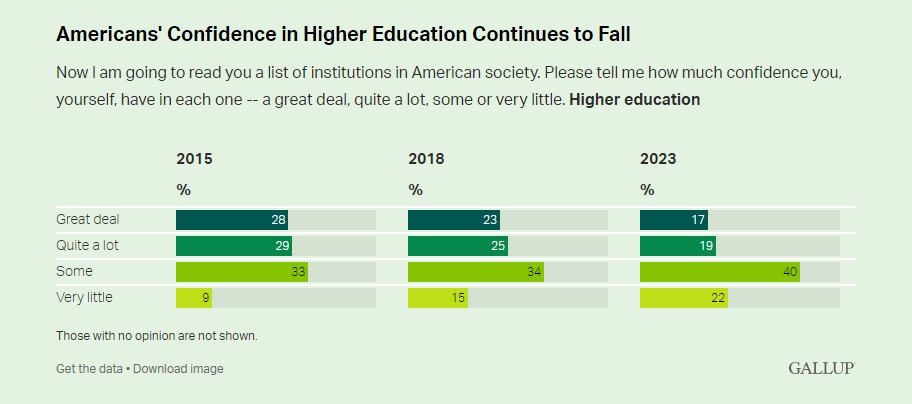
Noah Smith, at his Substack blog Noahopinion, posts poll data that shows a precipitous loss of faith in college among a wide swathe of Americans. (https://www.noahpinion.blog/p/americans-are-falling-out-of-love?utm_source=substack&utm_medium=email)

Here’s the grim chart that sums it all up:

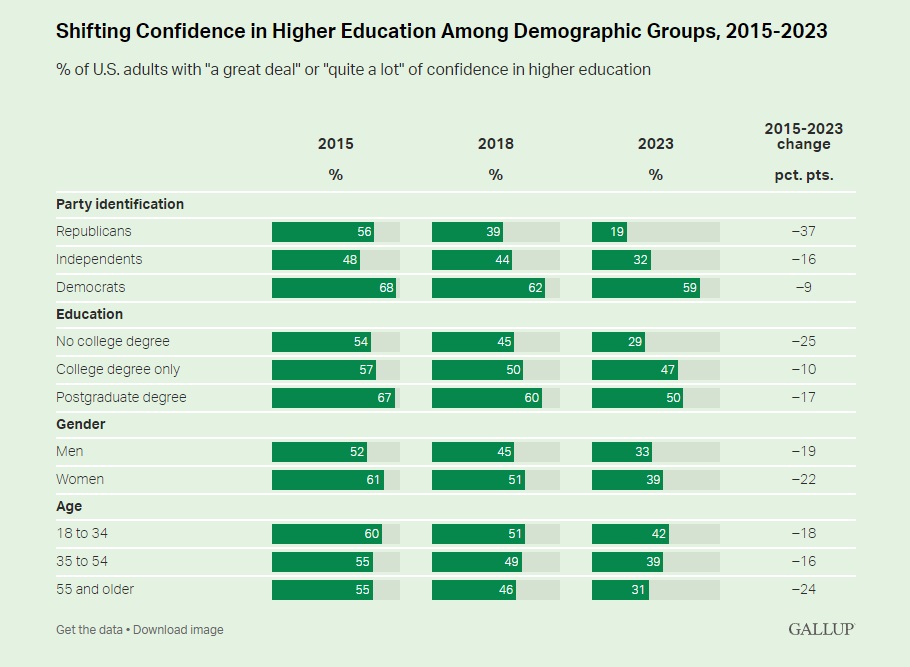
This disenchantment with college is more marked among Republicans—which is no surprise given the profound anti-intellectualism of current day Republican populism joined to the constant attacks upon universities as citadels of liberalism.  But Democrats also have much less faith in the usefulness of a college education.  Here’s the chart that details the demographic divides on this issue—helpfully giving us the percentage declines since in 2015 in the far right column.

I am just back from the Tennessee mountains where I was visiting with two friends who are English professors at the University of Tennessee. So the plight of the humanities inevitably came up.  Which isn’t exactly the decline of faith in college tout court.  But is adjacent to that decline.

Anyway, my line was: we no longer have any story at all that we can tell, that feels even remotely plausible, about why someone should be conversant with the cultural heritage represented by the texts of the past.  The only rationale anyone ever advances these days is about skills acquired as by-products of reading: critical thinking, pattern recognition, attention to detail, ability to track complex arguments or emotional states complete with competing points-of-view and ambiguous data etc.

Similar arguments are used to justify instruction in writing.  Vital communication skills and all the rest. 

But even its most ardent practitioners can no longer—in the face of a culture that clearly does not care in the least—make the case for being an educated or “cultured” person, where attaining that status entails familiarity with a cultural heritage marked by certain landmarks, with that familiarity widely shared. 

When I taught at the Eastman School of Music, our dean would often lament that the audience for classical music largely consisted of 60+ year olds.  What would happen when that audience died off? Well, so far, it turns out that the next cohort of 60 years olds takes their place. 

I am currently experiencing something similar.  I facilitate two different reading groups (with ten participants in each) of people in their 60s who want to read classics. My sixty year olds in the two reading groups are hungry for encounters with “great books.”  Some of the books are ones they read in college and want to revisit.  Other selections are books they have always wanted to tackle.  So we have read Homer, Dante, Augustine, Dostoyevsky, Joyce, Woolf, Cather, Morrison and Cervantes among others. (Both groups have been going strong for three years.)

Are my readers outliers?  Yes and No.  They are products of the time when most students were liberal arts majors (English, History, Religious Studies etc.) and then went on to professional careers in business, law, journalism, and even medicine. Like (I would argue) the classical music audience, they had early experiences reading “major authors” (just as the classical music audience had early experiences of learning to play piano or violin and were taken to hear orchestras.)  After reaching a certain pinnacle in their professional lives (and after the kids are grown and gone if they had them), these oldsters turn back to the classics.  Not everyone in their position makes this turn, but a fair number of people do.  They are hungry for the “culture” that they tasted for a while in youth, and now want to revisit it.

The current situation is different because, especially when it comes to books more so that when it comes to music, the early experience is not on offer.  A certain subset of the population still gets violin and piano lessons.  But fewer and fewer young people are getting Homer, Woolf, or Conrad in either high school or college.  There is no early imprinting taking place.

And what are my readers seeking? In a word: wisdom. They are looking for life lessons, aids to reflecting on their own lives.  They are just about completely uninterested in historical or cultural context, the kinds of things scholars care about.  So the humanities have an additional problem in the context of the research university which is supposed to “produce knowledge.” Why does a society want knowledge about the cultures of the past (its own culture and other cultures) and about its highlighted landmarks?  We humanists don’t have a good answer to that one when faced with the general indifference.  We can echo the complaints of Matthew Arnold about the philistines who prevail in our society, but we lack his faith that “culture” has something precious to offer that society.  And certainly even an attempt to activate Arnold’s vision of “culture” would have little relation to what counts as “scholarship” in the contemporary university. Arnold, too, was mostly focused on gleaning wisdom (“the best that has been thought”) from the classics–although he also hoped that attention to “culture” could provide a “disinterested,” reflective place to stand that would mitigate partisan wranglings. Even in 1867, that last one seemed pretty laughable, and certainly naive.

Still, there was a time when offering wisdom, or paths to maturation, or lessons in the practices of reflection was valued as something college could (and should) do.  But such vague values carry no water in our relentlessly economic times.  Starting in the 1980s (greed is good) when the gap between economic winners and losers began to widen and it also became clear that there was wealth beyond previous imaginings for the winners, return on investment became all.  The decline of support for college is pretty directly tied to a cost/benefit analysis that says the economic pay-off of a college degree has declined.

The facts of that matter are complex.  Overall, it’s still a winning economic strategy to get a college degree.  It is even unclear whether a degree in a “practical” major like business or health services carries a better economic return than a liberal arts degree in history or literary studies.  Determining the facts of this matter are complicated by the extent to which social/economic starting point influences the eventual outcomes along with where one degree is from (given the extreme status hierarchy in American higher education).

But it is simply wrong that college is an economic loser.  So why the decline in faith in college? One, the upfront costs are now so much higher than they once were.  People go into debt to get a college degree—and the burden of that debt weighs heavily on them precisely when they are setting out and in their most vulnerable, least remunerative years of their job lives. 

Second, the relentless attack on what is taught in college for the right wing outrage machine. The strong decline since 2015 registered in the Gallup poll is much stronger among the groups (Republicans and those without a college degree) most susceptible to right wing propaganda.

But we should recognize that the right-wing attack exists alongside a wider and growing sense that college’s sole purpose is job preparation. As a result, much of the traditional college curriculum simply seems beside the point, a waste of time.  The degree is what matters; the pathway to that degree is now deeply resented by many students.  It is experienced as a pointless, even sadistic, set of obstacles—and the sensible course of action is to climb over those obstacles in the most efficient way possible. (Hence the epidemic of cheating, and the documented increase in the numbers of students who think cheating is acceptable.)  What is offered in the classroom is experienced as having no value whatsoever.  The only value resides in the degree—a degree that is only slightly (if at all) connected to something actually learned (whether that be some acquired skills or something more nebulous like wisdom.) 

We humans seem particularly adept at this kind of reversal of values, making what at first was a marker of accomplishment into the aim of our endeavors.  Money becomes the goal instead of a signifier of values, only valuable insofar as it enables access to things needed for flourishing; in a similar fashion, the degree that was simply meant to signify educational acquisition of valuable knowledge is now the goal of the pursuit, with the actual knowledge radically devalued. 

Our politicians have acted on this reversal of values.  Public higher education is now driven by the imperative to deliver as many degrees for the least amount of public expenditure.  That the actual educational outcomes (measured in other terms than simply the number of degrees granted) are devastated by this approach doesn’t trouble them in the least because they buy into the general contempt for the actual content of what gets taught in the college classroom.  That the credential (the degree) is divorced from actual competence or knowledge apparently doesn’t bother them either.  It’s all numbers driven, with no attention at all to quality.

When we reached this point in this conversation among four English professors (the youngest of whom was 70), we lamented we had become the cranky oldsters we swore we would never become.  Spouting the all too predictable: “How it was so much better in our day.”  Another blogger I like, Kevin Drum, spends a lot of time debunking the notion that Americans, including young Americans, are worse off today than in years past. (Link to Drum’s blog: https://jabberwocking.com/) When one adjusts for inflation, housing costs and other economic indicators (like wages), things in the United States have been fairly steady over the past 70 years. The key point is that economic inequality has increased.  The lower half has mostly held steady, while the upper 20% has taken all of the wealth generated by economic growth over that time span.  So the have-nots are not more destitute (they are even slightly better off), but they have to witness the excesses of those who are much more wealthy than they were in the 1950s and 60s.

I think, however, that Drum misses the fact that economic anxiety is way higher, even if that is mostly a factor of the reaction to numbers.  To face a monthly rent of $3000 feels more daunting even if that’s only $350 in 1970 dollars.  The same goes for college tuition and student loan debts.  Especially when college costs have risen faster than the rate of inflation.

So the sheer sticker shock of college costs has to be seen as one factor in the disillusionment.  Despite generous aid packages, studies show that the price is off-putting for lower income students—precisely the students least likely to know about how aid works.  Add to that the fact that most aid packages also include loans and the upfront financial burdens and risks are daunting. 

I used to say there was only three things the world wanted to buy from the US: our Hollywood centered entertainment, our weapons, and our higher education. I think that may still be true, but we sure seem determined to undermine two of the three, leaving only our heavily subsidized defense industry standing.  Withdrawal of government support for education (shifting the costs onto students) hurts the one, while corporate greed (screwing the writers, actors, and other workers) hurts the other.

It is a truism that the periods when the arts flourish are also when a nation is most prosperous; think Elizabethan and Victorian England; 5th century Athens; early 15th century Florence etc.  The 1950s and the 1960s may not have been such a golden age for artistic achievement, but it was a time of economic well-being.  And that fact seems to have generated the confidence that allowed for a non-utilitarian ideal of a liberal arts education to flourish.  Yes, that ideal was a “gentlemanly” one, which meant it excluded women, non-whites, and large swathes of the working class.  But the GI Bill and the massive investment in public higher education during those years was the beginning of the opening up of that model of college to larger numbers.  The retreat from that ideal is not (as Kevin Drum’s work repeatedly demonstrates) the result of America being less prosperous in 2020 than it was is 1965.  Rather, it is the fact that completion for a piece of that wealth has been greatly increased.  An economy that produced general prosperity (again, with the important caveat that it excluded blacks from that prosperity) has been transformed into one where the gap between winners and losers has widened—and is ever present to every player in the field.  (Why do American workers not take their vacation time?  Because they are terrified that their absence will prove they are not essential—and so they will be laid off.)  The things that our society has decided it cannot “afford” are legion (health care for all; decent public transportation; paying competitive wages to keep teachers in the classroom).  Among those things is a college education that has only a tangential relation to a specific job as it aims to deliver other benefits, ones that can’t be easily or directly tied to a monetary outcome.