Category: Public Higher Education

Albert Einstein on the Humanities

A passage from Einstein, lifted from the compilation of his writings titled Ideas and Opinions (New York: Bonanza Books, 1954). Offered without comment.

It is not enough to teach a man a specialty. Through it he may become a kind of useful machine but not a harmoniously developed personality. It is essential that the student acquire an understanding of and a lively feeling for values. He must acquire a vivid sense of the beautiful and of the morally good. Otherwise he–with his specialized knowledge–more closely resembles a well-trained dog than a harmoniously developed person. He must learn to understand the motives of human beings, their illusions, and their sufferings in order to acquire a proper relationship to individual fellow-men and to the community.

These precious things are conveyed to the younger generation through personal contact with those who teach, not–or at least not in the main–through textbooks. It is this that primarily constitutes and preserves culture. This is what I have in mind when I recommend the “humanities” as important, not just dry specialized knowledge in the fields of history and philosophy.

Overemphasis on the competitive system and premature specialization on the grounds of immediate usefulness kills the spirit on which all cultural life depends, specialized knowledge included.

It is also vital to a valuable education that independent critical thinking be developed in the young human being, a development that is greatly jeopardized by overburdening him with too much and with too varied subjects (point system). Overburdening necessarily leads to superficiality. Teaching should be such that what is offered is perceived as a valuable gift and not as a hard duty. (Originally published in the New York Times of October 5, 1952.)

Americans Are Down on College

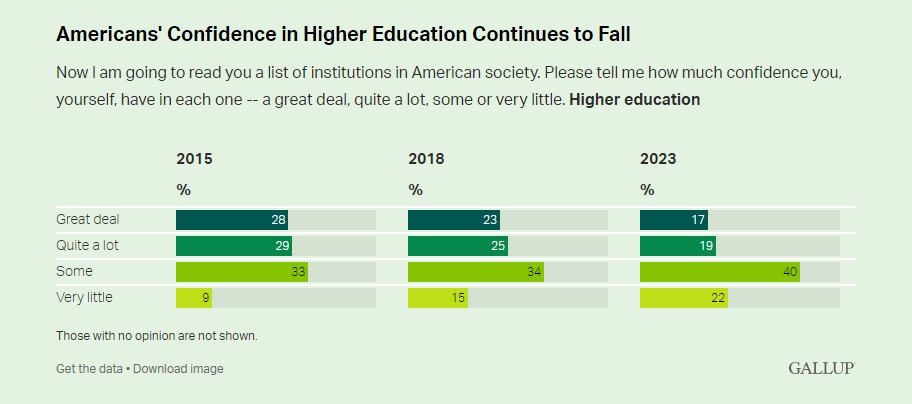
Noah Smith, at his Substack blog Noahopinion, posts poll data that shows a precipitous loss of faith in college among a wide swathe of Americans. (https://www.noahpinion.blog/p/americans-are-falling-out-of-love?utm_source=substack&utm_medium=email)

Here’s the grim chart that sums it all up:

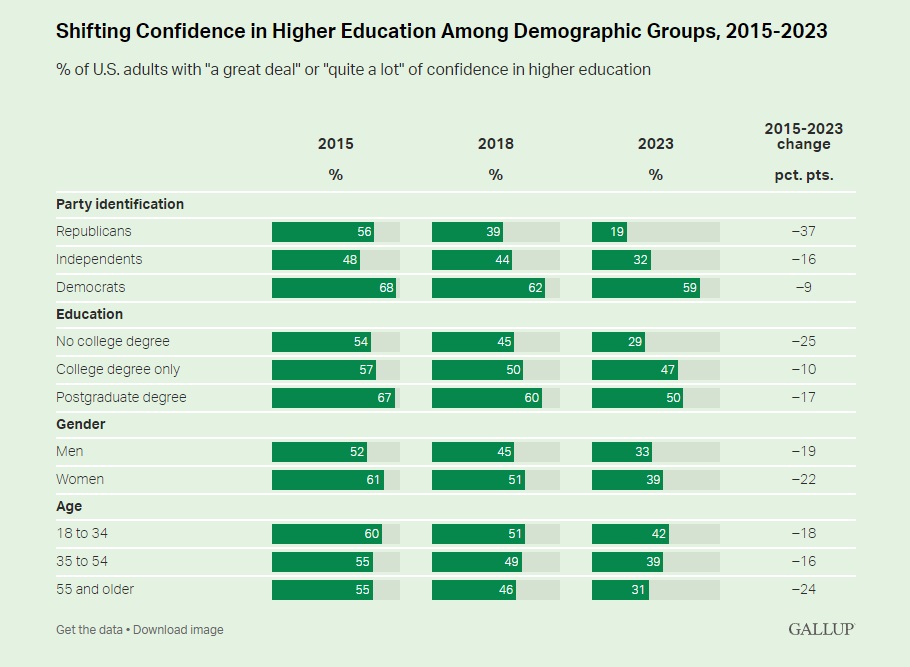
This disenchantment with college is more marked among Republicans—which is no surprise given the profound anti-intellectualism of current day Republican populism joined to the constant attacks upon universities as citadels of liberalism.  But Democrats also have much less faith in the usefulness of a college education.  Here’s the chart that details the demographic divides on this issue—helpfully giving us the percentage declines since in 2015 in the far right column.

I am just back from the Tennessee mountains where I was visiting with two friends who are English professors at the University of Tennessee. So the plight of the humanities inevitably came up.  Which isn’t exactly the decline of faith in college tout court.  But is adjacent to that decline.

Anyway, my line was: we no longer have any story at all that we can tell, that feels even remotely plausible, about why someone should be conversant with the cultural heritage represented by the texts of the past.  The only rationale anyone ever advances these days is about skills acquired as by-products of reading: critical thinking, pattern recognition, attention to detail, ability to track complex arguments or emotional states complete with competing points-of-view and ambiguous data etc.

Similar arguments are used to justify instruction in writing.  Vital communication skills and all the rest. 

But even its most ardent practitioners can no longer—in the face of a culture that clearly does not care in the least—make the case for being an educated or “cultured” person, where attaining that status entails familiarity with a cultural heritage marked by certain landmarks, with that familiarity widely shared. 

When I taught at the Eastman School of Music, our dean would often lament that the audience for classical music largely consisted of 60+ year olds.  What would happen when that audience died off? Well, so far, it turns out that the next cohort of 60 years olds takes their place. 

I am currently experiencing something similar.  I facilitate two different reading groups (with ten participants in each) of people in their 60s who want to read classics. My sixty year olds in the two reading groups are hungry for encounters with “great books.”  Some of the books are ones they read in college and want to revisit.  Other selections are books they have always wanted to tackle.  So we have read Homer, Dante, Augustine, Dostoyevsky, Joyce, Woolf, Cather, Morrison and Cervantes among others. (Both groups have been going strong for three years.)

Are my readers outliers?  Yes and No.  They are products of the time when most students were liberal arts majors (English, History, Religious Studies etc.) and then went on to professional careers in business, law, journalism, and even medicine. Like (I would argue) the classical music audience, they had early experiences reading “major authors” (just as the classical music audience had early experiences of learning to play piano or violin and were taken to hear orchestras.)  After reaching a certain pinnacle in their professional lives (and after the kids are grown and gone if they had them), these oldsters turn back to the classics.  Not everyone in their position makes this turn, but a fair number of people do.  They are hungry for the “culture” that they tasted for a while in youth, and now want to revisit it.

The current situation is different because, especially when it comes to books more so that when it comes to music, the early experience is not on offer.  A certain subset of the population still gets violin and piano lessons.  But fewer and fewer young people are getting Homer, Woolf, or Conrad in either high school or college.  There is no early imprinting taking place.

And what are my readers seeking? In a word: wisdom. They are looking for life lessons, aids to reflecting on their own lives.  They are just about completely uninterested in historical or cultural context, the kinds of things scholars care about.  So the humanities have an additional problem in the context of the research university which is supposed to “produce knowledge.” Why does a society want knowledge about the cultures of the past (its own culture and other cultures) and about its highlighted landmarks?  We humanists don’t have a good answer to that one when faced with the general indifference.  We can echo the complaints of Matthew Arnold about the philistines who prevail in our society, but we lack his faith that “culture” has something precious to offer that society.  And certainly even an attempt to activate Arnold’s vision of “culture” would have little relation to what counts as “scholarship” in the contemporary university. Arnold, too, was mostly focused on gleaning wisdom (“the best that has been thought”) from the classics–although he also hoped that attention to “culture” could provide a “disinterested,” reflective place to stand that would mitigate partisan wranglings. Even in 1867, that last one seemed pretty laughable, and certainly naive.

Still, there was a time when offering wisdom, or paths to maturation, or lessons in the practices of reflection was valued as something college could (and should) do.  But such vague values carry no water in our relentlessly economic times.  Starting in the 1980s (greed is good) when the gap between economic winners and losers began to widen and it also became clear that there was wealth beyond previous imaginings for the winners, return on investment became all.  The decline of support for college is pretty directly tied to a cost/benefit analysis that says the economic pay-off of a college degree has declined.

The facts of that matter are complex.  Overall, it’s still a winning economic strategy to get a college degree.  It is even unclear whether a degree in a “practical” major like business or health services carries a better economic return than a liberal arts degree in history or literary studies.  Determining the facts of this matter are complicated by the extent to which social/economic starting point influences the eventual outcomes along with where one degree is from (given the extreme status hierarchy in American higher education).

But it is simply wrong that college is an economic loser.  So why the decline in faith in college? One, the upfront costs are now so much higher than they once were.  People go into debt to get a college degree—and the burden of that debt weighs heavily on them precisely when they are setting out and in their most vulnerable, least remunerative years of their job lives. 

Second, the relentless attack on what is taught in college for the right wing outrage machine. The strong decline since 2015 registered in the Gallup poll is much stronger among the groups (Republicans and those without a college degree) most susceptible to right wing propaganda.

But we should recognize that the right-wing attack exists alongside a wider and growing sense that college’s sole purpose is job preparation. As a result, much of the traditional college curriculum simply seems beside the point, a waste of time.  The degree is what matters; the pathway to that degree is now deeply resented by many students.  It is experienced as a pointless, even sadistic, set of obstacles—and the sensible course of action is to climb over those obstacles in the most efficient way possible. (Hence the epidemic of cheating, and the documented increase in the numbers of students who think cheating is acceptable.)  What is offered in the classroom is experienced as having no value whatsoever.  The only value resides in the degree—a degree that is only slightly (if at all) connected to something actually learned (whether that be some acquired skills or something more nebulous like wisdom.) 

We humans seem particularly adept at this kind of reversal of values, making what at first was a marker of accomplishment into the aim of our endeavors.  Money becomes the goal instead of a signifier of values, only valuable insofar as it enables access to things needed for flourishing; in a similar fashion, the degree that was simply meant to signify educational acquisition of valuable knowledge is now the goal of the pursuit, with the actual knowledge radically devalued. 

Our politicians have acted on this reversal of values.  Public higher education is now driven by the imperative to deliver as many degrees for the least amount of public expenditure.  That the actual educational outcomes (measured in other terms than simply the number of degrees granted) are devastated by this approach doesn’t trouble them in the least because they buy into the general contempt for the actual content of what gets taught in the college classroom.  That the credential (the degree) is divorced from actual competence or knowledge apparently doesn’t bother them either.  It’s all numbers driven, with no attention at all to quality.

When we reached this point in this conversation among four English professors (the youngest of whom was 70), we lamented we had become the cranky oldsters we swore we would never become.  Spouting the all too predictable: “How it was so much better in our day.”  Another blogger I like, Kevin Drum, spends a lot of time debunking the notion that Americans, including young Americans, are worse off today than in years past. (Link to Drum’s blog: https://jabberwocking.com/) When one adjusts for inflation, housing costs and other economic indicators (like wages), things in the United States have been fairly steady over the past 70 years. The key point is that economic inequality has increased.  The lower half has mostly held steady, while the upper 20% has taken all of the wealth generated by economic growth over that time span.  So the have-nots are not more destitute (they are even slightly better off), but they have to witness the excesses of those who are much more wealthy than they were in the 1950s and 60s.

I think, however, that Drum misses the fact that economic anxiety is way higher, even if that is mostly a factor of the reaction to numbers.  To face a monthly rent of $3000 feels more daunting even if that’s only $350 in 1970 dollars.  The same goes for college tuition and student loan debts.  Especially when college costs have risen faster than the rate of inflation.

So the sheer sticker shock of college costs has to be seen as one factor in the disillusionment.  Despite generous aid packages, studies show that the price is off-putting for lower income students—precisely the students least likely to know about how aid works.  Add to that the fact that most aid packages also include loans and the upfront financial burdens and risks are daunting. 

I used to say there was only three things the world wanted to buy from the US: our Hollywood centered entertainment, our weapons, and our higher education. I think that may still be true, but we sure seem determined to undermine two of the three, leaving only our heavily subsidized defense industry standing.  Withdrawal of government support for education (shifting the costs onto students) hurts the one, while corporate greed (screwing the writers, actors, and other workers) hurts the other.

It is a truism that the periods when the arts flourish are also when a nation is most prosperous; think Elizabethan and Victorian England; 5th century Athens; early 15th century Florence etc.  The 1950s and the 1960s may not have been such a golden age for artistic achievement, but it was a time of economic well-being.  And that fact seems to have generated the confidence that allowed for a non-utilitarian ideal of a liberal arts education to flourish.  Yes, that ideal was a “gentlemanly” one, which meant it excluded women, non-whites, and large swathes of the working class.  But the GI Bill and the massive investment in public higher education during those years was the beginning of the opening up of that model of college to larger numbers.  The retreat from that ideal is not (as Kevin Drum’s work repeatedly demonstrates) the result of America being less prosperous in 2020 than it was is 1965.  Rather, it is the fact that completion for a piece of that wealth has been greatly increased.  An economy that produced general prosperity (again, with the important caveat that it excluded blacks from that prosperity) has been transformed into one where the gap between winners and losers has widened—and is ever present to every player in the field.  (Why do American workers not take their vacation time?  Because they are terrified that their absence will prove they are not essential—and so they will be laid off.)  The things that our society has decided it cannot “afford” are legion (health care for all; decent public transportation; paying competitive wages to keep teachers in the classroom).  Among those things is a college education that has only a tangential relation to a specific job as it aims to deliver other benefits, ones that can’t be easily or directly tied to a monetary outcome.

Crisis of Conscience in the Arts and Humanities

The current crises (multiple) in the US and the world has generated a very specific crisis of conscience among practitioners in the arts and humanities.  From the Mellon Foundation’s shift in funding priorities to my daughter-in-law’s small theater company and the anguished discussion on Victorian studies listservs about justifications for teaching/studying Dickens, those practitioners are agonizing over how their work (which they enjoy and want to continue doing) contributes to social justice.  “If you are not part of the solution, you are part of the problem” troubles people of good will with special urgency in the current moment.

Retirement is a time for reflection.  I think of what I have done with my life, of the choices I made.  Those choices were, in one way, quite haphazard.  I did not have a plan; I was opportunistic.  I knocked on the doors that presented themselves and walked through the ones that opened. I almost never turned down an invitation to do something—and one thing led to another.  All of it, however, was within the structures of an academic career, and constituted advances along fairly clearly mapped out career paths.  Once having secured tenure, the choices I made were all safe ones.  I never put myself at serious risk in terms of financial and career security, even as I did not stick to a field or a discipline.  I was more of a free-floating intellectual, but within an institutional place where that carried no significant risks.  In that sense, I was less “careerist” than many academics, but my being a bit of a maverick came at no cost and was hardly anything like significant rebellion.  I maintained a steady distaste for, even contempt of, much academic business as usual, but let my colleagues go their way so long as they let me go mine.

What did I accomplish besides garnering my fair share of rewards?  Not much.  Tops among the rewards was working with students—and enabling some of them to go on to their own successes.  When the fairly obvious paths for a career began to close down, making the possible way forward to students increasingly murky, much of the joy of my work began to dissipate.  I couldn’t justify what I was doing in terms of the ways it provided opportunities for my students to advance.  And while the scholarship itself (as evidenced by this blog), my engagement with ideas and arguments, continued (and continue) to interest me, that pursuit seemed more and more like self-indulgence.  It does no good to anyone—a fitting way to spend my retired time if I wish, but hardly an activity that society should feel any need or responsibility to support.  I am cultivating my own garden, which seems a betrayal of our needy world.  But I can’t figure out where my efforts could be better directed.

All of this as a long preamble to an email I recently sent to a former student, now a professor of Victorian studies, when she wrote to me about the current discussion on those listserv about reading/teaching/studying Dickens.  Here’s what I wrote back”


“As for studying Dickens, I share your inability to think straight on the topic.  I have two fairly recent posts on my blog–the titles include the terms “cakes and ale” so searching that way will get you the posts–that are relevant.  I think people will keep reading Dickens in the wider world no matter what the academy does, whereas I think some authors–Smollett, Oliphant, Meredith–would disappear altogether if there weren’t scholars reading and writing on them.

But whether the academy should devote resources to scholarship on Dickens and have courses where students are made to read him is a much tougher question.  I do think it highly, highly likely that Victorian studies will slowly fade out of existence–and I do think that’s a mostly bad thing even though I also understand that Victorian studies does little, if anything, to address the massive problems that our world faces.  That’s the dilemma my posts try to address: how to justify activities and scholarship that are not necessary in the sense of not directed toward issues of social justice.  “Not directed” meaning that, even if that scholarship talks about social justice, it is not doing anything concrete to bring social justice about.

My advice for you remains the same.  Play the game by the rules that currently apply.  Get tenure.  And then, with that security obtained, consider what work you can do with a good conscience, making you feel you are contributing toward something you can affirm.  For me, that mostly meant helping my students make their way forward in the world while writing and reading about things I felt germane to articulating a vision of what we should want a democratic society look like.

But all that definitely often felt very removed from making the world a better place.  The helplessness of looking on, and the guilt of doing that looking on from a secure place, did often make me accuse myself of cowardice.  I should have been putting myself on the line and doing something direct instead of pursuing my very pleasant indirect path.

There is a question of temperament here–although it can also seem a question of selfishness.  I have worked in political campaigns since I was 18, and I find I am not suited to it.  I believe much of what campaigns do is futile make-work (phone banks and canvassing, of which I have done a fair amount without any sense that it is effective) and I also find the focus on winning the election at the expense of much investment in what one is winning the election to achieve troubling.  Finally, in my one experience dealing with Congress (I was part of a team trying to influence the writing of a legal aid bill), the compromises we had to swallow and the pettiness and ignorance of the representatives we had to deal with was a massive turn-off.  The political process–no surprise–is very broken.  So a retreat back into academia, where at least I could control my relations to my colleagues and students, and act in ways I could affirm toward them, was a huge relief.

More than you wanted to hear doubtless.  But how to make one’s way through a life lived in a corrupt and cruel society is a real dilemma.  How to maintain self-respect and some sense of investment in what one is doing day in and day out even as you bemoan the state of the world and feel you should contribute to making it better.  Not a trivial problem. “


Cakes, Ale, and Mellon (2)

My post on the Mellon Foundation’s announcement that it would orient all its future funding decisions toward projects that advance social justice generated a conversation on Facebook.  You can read the give-and-take by going to my FaceBook page.

Here I want to make my position clear (which is hard because I have mixed feelings on the topic)—and elaborate on my rationale for those feelings.

Let me state my opinion at the outset—and then the rest of the post tries to explain that opinion.  Mellon has been the biggest foundation funder (by orders of magnitude) of work in the arts and humanities for many years now.  It was especially important because it funded institutions—museums, theaters, dance companies, learned societies, universities, small presses and the like—as well as individuals.  And (this is my big point) is was one of very few places where people in the arts and humanities did not have to justify their work by reasons external to the work itself.  You certainly had to convince Mellon that the work you were doing was of excellent quality and make a case that it was deemed significant and superb in the relevant field, but you didn’t have to claim external benefits.

Why is that important?  Because the arts and humanities cannot exist in a market society unsubsidized.  The major source of subsidy is the educational system, from kindergarten through to universities.  95% (to pick a plausible number out of thin air) of artists and humanists will make the majority of their income from teaching.  And that means the arts and humanities are continually burdened with making the case that they are pedagogically useful.  The insistence that that case be made—accompanied by an increasing skepticism about that case—is familiar to anyone who works in these fields. So Jessica Berman is absolutely right that we need to be adept at making that case since we will be called on—repeatedly—to make it.

But that need to make the case means the arts and humanities are continually and increasingly on the defensive, trapped within a game they cannot win but must play.  Thus the endless shouting into the wind about the benefits of a liberal arts education.  I am not saying those arguments are untrue.  I am simply saying they never convince the people who demand that we make those arguments even though they have closed their minds to them long ago.  It’s a pointless, frustrating, undermining game.  What a relief it was to not have to play it to secure support from Mellon.

Now let me tell you a true story.  I taught in the Humanities Department of the Eastman School of Music for eight year.  My students were all aspiring musicians.  Because I am deeply committed to the notion of an informed citizenry, my classes there were usually designed to give students an understanding of the state of these United States.  At the end of one semester, a promising young pianist came to tell me he was going to abandon music because the world was in too bad a shape for him to continue in good conscience.  I hope that you would in a similar circumstance be as horrified as I was.

That was not what I meant at all, I hastened to tell him.  I want you to be an informed democratic citizen, but I never intended to make you think you should give up trying to become a concert pianist.  You have an enormous talent and the world needs great pianists.  Your first responsibility to yourself and to the world is the nurturing of your talent.

Here comes the hard part.  I don’t think Beethoven and golf are significantly different as human endeavors.  Both are difficult, intricate, capable of being endlessly fascinating.  To become a master of either you need to be obsessed to the point of being a bit crazy, certainly to the point of neglecting much else that most of us think part and parcel of a well-rounded life.  Both deliver something to the practitioner (discipline, interest, satisfaction/frustration) and to those who enjoy watching/listening to adept practitioners (fandom, pleasure, the joy of watching something very difficult being done superbly well).  I don’t really see (despite the somersaults we go through—and it is always somersaults if Adorno is our guide) that claims about why Beethoven should be in the school curriculum but not golf hold water.  If it’s complexity and mental agility and an ability to pay close attention that we are after, golf could do the trick just as well.

This last point is driven home (admittedly to my despair) by the fact that sports are a much larger presence in our schools than the arts and humanities.  Certainly in terms of money spent, sports (at least from ninth grade on) garner much larger budgets.  And when (as is seldom the case, but not never) sports have to justify their presence in the curriculum, they offer reasons that echo the ones trotted out to justify the liberal arts.  Reasons about mental discipline, learning to work with others etc. (Side note: isn’t it wonderful that Stanford has dropped eleven sports instead of cutting the music department?  Let’s hope other universities follow their lead.)

What about social justice?  I hate to think of the somersaults that are going to be required to demonstrate that work on Beethoven will contribute to social justice.  (As I said in my first post, I predict the route taken will be to make Beethoven more available to audiences traditionally unexposed to him.)  Some authors (Dickens, Carolyn Forché) are going to be much easier to link to a social justice agenda than others (Nabokov, Jorie Graham).

Even with the more obviously politically relevant authors, I think the rationale is often a subterfuge.  I think of all the work in the past thirty years about Melville’s relationship to slavery.  Solid work—but driven, I think, primarily by an interest in Melville not by an interest in slavery.  Melville was not an important figure in abolitionist circles; if you are really interested in the history of slavery in the US, of attitudes toward it, and its practices, Melville is way down the list of places you would go.  He only acquired any significance long after slavery was abolished, and our investment in him now is disciplinary (having to do with the canon) and aesthetic (in the sense that we think him a superb novelist).  Yes, we want to know about his reactions to slavery—but not because they tell us all that much about slavery and abolition efforts, but because they tell us about Melville who we think is significant enough as an artist that knowing more about him is worthwhile.  What drives the scholarship is not the advancement of social justice, but the advancement of our knowledge of Melville.

I know I am going to be misunderstood on this point.  So let me state it in different words.  Literary studies bestows authority on certain figures; it has a canon.  Efforts to break open that canon—and to examine the processes that go into its formation—are (I think) directly political.  But such efforts have been modestly successful.  The undergraduate curriculum, even for majors, remains mostly canonical.  And scholarship, while certainly more historicist over the past forty years, still tends to be anchored by one or two “major” figures even as it explores less honored (or taught) writers.  It is the authority attached to those major figures that still matters greatly—with its assumption that 1) learning more about those writers is a self-justifying scholarly motive in the discipline, and 2) that what those major figures thought and did is significant because of who they are. (The kind of circular reasoning about significance that drove Barbara Herrnstein Smith crazy in her attack on aesthetics, Contingencies of Value.)

To state for about the millionth time in my lifetime, my basic take on this relationship between art/scholarship and politics.  I just don’t buy that writing about social class in Dickens is political, and certainly don’t see it as an advancement of social justice.  Political work engages in changing institutions, in working on facts on the ground.  Scholarly work can change political opinions, just as Dickens’ novels can, but we have a very attenuated sense of the political if we think that our job is done when we teach Bleak House and write an essay about its views of social responsibility.  If, in fact, our reason for being in the classroom and doing our scholarship is political, then we are acting in bad faith.  If you really take politics as your primary motive in life, then making art or writing literary criticism is not what you should be doing.

I don’t think we advance social justice one iota if we confuse direct political action with the indirect attention to political questions that can occur in our classrooms and in our scholarship.  So my fear is that Mellon’s insistence that we tie our work to social justice will just abet this confusion of the direct with the indirect.  It is hard enough to be honest about our motives for what we devote our time and energy to.  And it is equally hard to be realistic about what our work can and cannot accomplish.  I think Mellon’s new orientation will encourage comforting lies we already too often are tempted to tell ourselves.

To be blunt: I hate the gestural politics on display at the Whitney and in the halls of the MLA.  It’s cheap in the sense that it costs its practitioner nothing and seems mostly directed at garnering the approval of his peers.  There are, of course, notable exceptions—Banksy, James Baldwin, and Edward Said come to mind immediately—so I need to be careful not to claim that it is impossible for art and scholarship to be political.  But it is damn difficult.

If our work as artists and teachers is not political, what is it?  I have backed myself into a corner here, pushing me toward an answer I would have scorned most of my (misdirected? misunderstood?) career. (In short, I was as committed, maybe even more so, to literary studies’ efforts to be political–and thus avoided saying, to myself or others, what I was actually practicing everyday as a teacher.) Cultivation of a sensibility of open-ness and appreciation.

Another story to indicate what I mean.  Some years back I discovered that all the students in a class I was teaching had never seen “Casablanca.”  My deepest commitments were brought home to me.  I didn’t deeply care if they never read Pope’s “Epistle to Man,” but to never see “Casablanca” would be to go to the grave without having passed through life.  My goal as a teacher was to open eyes to the richness of the word and the life it was possible to live in that world. To move my students toward the “quickened consciousness” Pater extolled. That goal did mean I wanted them to see how cruel, how unequal, how unjust the contemporary world is, but bringing that point home was part of the larger project of their seeing “life” and “the world” in all its many-sided splendor and squalor.  And it is in the arts that that splendor and squalor are most fully on display.

This last point brings me back to cakes and ale.  William James was interested in what he called “moral holidays.”  He did not mean the term pejoratively.  He knew that everyone of us grants ourselves such holidays.  So how do we justify them?  Peter Singer is the utilitarian philosopher who makes the absolutely stringent case against such holidays.  There is no way, Singer argues, to justify spending $150 to see “Hamilton” when that same sum, given to Oxfam, can feed 40 people.  No cakes and ale without an obligatory side dish of guilt.

Singer’s challenge returns us to my Eastman student’s crisis of conscience about playing the piano.  We can do somersaults to justify our cakes an ale. Even when admitting they are no good for the world or even to ourselves (sugar and alcohol?), we will talk about psychological well-being, letting off steam, all work and no play, etc. etc.  Because, of course, we all do take moral holidays.

My utopia is a world where we are relieved of the felt necessity to justify the holidays.  They are just good in and of themselves.  (Of course, traditional aesthetics keeps returning to this issue of intrinsic value again and again.)  There is nothing wrong about pleasure, about things that fascinate us by their intricacy and difficulty (we can imagine the “holidays whisperer” crooning in our ear.)

Hannah Arendt, with her obsession with amor mundi (love of the world), approached these issues in a somewhat different way.  She talks about the “freedom from politics” as among the freedoms to be protected and cherished.  One hallmark of totalitarianism is that everything becomes political; nothing gets to escape signifying one’s political allegiances, and one is either applauded or persecuted for every single taste or action. We are in a bad way when wearing a mask during a pandemic becomes politicized.  Zones of the non-political are liberating in the way that “moral holidays” are.

Just think of how dreary a world without music, without novels, without holidays would be. That world would certainly be hard to love. That’s all the justification we need.  More importantly, it is all the justification we are going to get.  All the other rationales are threadbare, barely plausible.

Mellon used to be a place where you didn’t have to do lip service by trotting out those all too familiar rationalizations.  Apparently no more.