Novak Djokovic and George Eliot: On Great Books (3)

I find myself compelled to return to the topic of great books as a result of reading Middlemarch with one of my reading groups.  To recap: I have argued that 1) our judgments of books changes over time and is context sensitive (cultural standards and sensibilities change); 2) that institutional inertia and imprimatur mean that a canon gets established and remains stable over long periods for “elite” or institutionally embedded opinion; revolutions in taste happen suddenly after long resistance to the revolution (akin to the idea of a “tipping point” or Thomas Kuhn’s notion of a “paradigm shift”); and 3) it hardly makes sense to rank order a set consisting of all novels since there is such variety within the set (what could it mean to compare Moby Dick to one of the Jeeves novels?) and that what is deemed “best” in any context is relative to the purposes that drive the judgment or choice.  Wodehouse is better than Melville on some occasions and for certain purposes.  In short, variety (diversity) reigns—both in the objects being judged and in the purposes that would underline any specific act of judgment.

Then I started reading Middlemarch and wondered if I simply was wrong.  That there are some achievements of human agents that simply make one shake one’s head in wonder: how could a human being be capable of that?  The breadth of vision in Middlemarch, the ability to imagine a whole world with an astounding cast of characters, startles—and humbles.  It seems a feat only one person in a million could pull off.  It is, in short, a masterpiece.  And masterpieces are all too rare.

Now it is possible to say Wodehouse also wrote masterpieces—given his aims and the genre in which he was working.  And it is certainly reasonable to prefer reading Wodehouse to Middlemarch on many occasions.  We get to one sticky issue here, the one best represented by Matthew Arnold insisting that Chaucer was not top drawer because his work lacked “high seriousness.”  One prejudice in the “great books” canon-making is some notion (vague enough) of profundity.  This is why tragedy has always been ranked above comedy, why King Lear is generally deemed greater than Twelfth Night despite each being of high quality in its chosen genre. 

I don’t have anything that strikes me as worth saying about this profundity issue.  I only think it should be acknowledged as a standard of judgment—and that it should be acknowledged that it is only one among many standards.  And I don’t think it should be a standard that trumps all the others.  Let’s discuss King Lear’s greatness in a way that specifies the standards by which we deem it great—and not indulge in meaningless comparisons to Twelfth Night, a play whose greatness is best understood in relation to other standards.

But—and here’s the rub, the reason for this blog post—I still find myself wanting to talk about the greatness of these Shakespeare plays.  Just sticking to Shakespeare, comparing apples to apples, I am going to say Twelfth Night is better than Two Gentlemen of Verona; and that King Lear is better than Coriolanus.  There are cases where the things to be compared are within the same domain—and one can be judged better than the other.  In the realm of realistic novels that aspire to a totalizing view of a certain social scene, Middlemarch is better than Sybil.  Of course, one is called upon to provide the reasons that undergird these judgments.

All of this brings me to Novak Djokovic—and the core doubt that drives this post (and this re-vision of my two earlier posts on “great books”).  What is astounding about Djokovic is the gap between him and most of the incredibly talented men’s tennis players in the world.  The twentieth best tennis player in world has almost no chance of beating Djokovic (especially in a five set match).  There are, in fact, only (at absolute most) ten players in the world who could beat him—and even in that case he would win the match against them well over half the time. 

My point is the extreme pyramid of talent.  That the gap between the tenth best player in the world and the absolutely best player is so wide defies explanation and belief.  It seems much more plausible to expect that the top rung of talent would be occupied by at least a group.   There are, after all, many aspiring tennis players and novelists who have put in the hours (Malcolm Gladwell’s famous “ten thousand hours”), yet do not reach the pinnacle.  Why is extreme talent, extreme achievement, so rare? I have no answer here. Talent is a mystery, what Shakespeare would have called “fortune”–unearned, simply implanted in the person. Of course, it is possible to waste one’s talents, just as it is crucial to nurture and hone one’s talents. But it is nonsense to think Djokovic’s supremacy is the product of his working harder and being more monomonaically dedicated to being the best tennis player in the world than his competitors. There are plenty of people just as dedicated to that goal as he is. They just lack his talent.

Could it be, then, that the term “great book” makes sense if used to designate those instances of extreme achievement, those cases where we encounter a work of human hands that awes us because it is so far beyond what most humans, even ones dedicated and talented in that specific field of endeavor, ever manage to accomplish? 

Great Books 2: Institutions, Curators, and Partisans

I find that I have a bit more to say on the topic of “great books.” 

The scare quotes are not ironic—or even really scare quotes.  Instead, they are the proper punctuation when referring to a word as a word or a phrase as a phrase.  As in, the word “Pope” refers to the head of the Catholic Church.  The phrase “great books” enters into common parlance with University of Chicago President Robert Maynard Hutchins’s establishment of a great books centered curriculum there in the 1930s.  From the Wikipedia page on Hutchins: “His most far-reaching academic reforms involved the undergraduate College of the University of Chicago, which was retooled into a novel pedagogical system built on Great Books, Socratic dialogue, comprehensive examinations and early entrance to college.”  The University of Chicago dropped that curriculum shortly after Hutchins stepped down in the early 1950s, with St John’s College now the only undergraduate institution in the country with a full-bore great books curriculum.  Stanford and Columbia had a very great books slanted general education set of requirements for first and second year undergraduates well into the 1990s, but have greatly modified that curriculum in the 21st century.

These curricular issues are central to what I want to write about today.  “Literature,” Roland Barthes once said, “is what gets taught.”  It is very hard to even have a concept of “great books” apart from educational institutions, from what students are required to read, from what a “well-educated” person is expected to be familiar with.  As I wrote a few posts back (https://jzmcgowan.com/2023/07/31/americans-are-down-on-college/), we in the United States seem now to have lost any notion of what a “well-educated” person is or should be.  The grace notes of a passing familiarity with Shakespeare or Robert Frost are now meaningless.  The “social capital” accruing to being “cultured” (as outlined in Pierre Bourdieu’s work) has absolutely no value in contemporary America (apart, perhaps, from some very rarified circles in New York). 

I am not here to mourn that loss.  As I said in my last post, aesthetic artefacts are only “alive” if they are important to some people in a culture.  Only if some people find that consuming (apologies for the philistine word) an artistic work is fulfilling, even essential to their well-being, will that work avoid falling into oblivion, totally forgotten as most work of human hands (artistic or otherwise) is. 

Today, instead, I want to consider how it is that some works do survive.  I think, despite the desire from Hume until the present, that the intrinsic greatness of the works that survive is not a satisfactory explanation.  More striking to me is that the same small group of works (easily read within a four year education) gets called “great”—and how hard it is for newcomers to break into the list.  For all the talk of “opening up the canon,” what gets taught in America’s schools (from grade school all the way up through college) has remained remarkably stable.  People teach what they were taught.

Yes, Toni Morrison, Salman Rushdie, and Gabriel Garcia Marquez have become “classics”—and are widely taught.  But how many pre-1970 works have been added to the list of “greats” since 1970?  Ralph Ellison and Frederick Douglass certainly.  James Baldwin is an interesting case because he has become an increasingly important figure while none of his works of fiction has become a “classic.”  On the English side of the Atlantic, Trollope has become more important while Shelley has been drastically demoted and Tennyson’s star is dimming fast.  But no other novelist has challenged the hegemony of Austen, the Brontës, Dickens, and Eliot among the Victorians, or Conrad, Joyce, Hardy, and Woolf among the modernists.  The kinds of wide-scale revaluations of writers that happened in the early years of the 20th century (the elevations on Melville and Donne, for example) have not happened again in the 100 years since.  There really hasn’t been any significant addition to the list (apart from Douglass and barring the handful of new works that get anointed) since 1930.

I don’t deny that literary scholars for the most part read more widely and write about a larger range of texts than such scholars did in the 1950s and 1960s.  (Even that assumption should be cautious.  Victorian studies is the field I know best and the older scholars in that field certainly read more of the “minor” poets of the era than anyone who got a PhD in the 1980s or later ever does.)  But the wider canon of scholars has not trickled down very much into the undergraduate curriculum.  Survey courses in both British and American literature prior to 1945 are still pretty much the same as they were fifty years ago, with perhaps one or two token non-canonical works.  More specialized upper class courses and grad courses are sometimes more wide-ranging.  Most significantly, the widening academic canon has not moved into general literate culture (if that mythical beast even exists) at all.

The one place where all bets are off is in courses on post 1945 literature.  No canon (aside from Ellison, Morrison, Rushdie, Baldwin) has been established there, so you will find Nabokov read here and Roth read there, while the growth of “genre courses” means Shirley Jackson and Philip K. Dick are probably now taught more frequently than Mailer or Updike or Bellow.  Things are not as unstable on the British side, although the slide has been toward works written in English by non-English authors (Heaney, Coetzee, various Indian novelists alongside Rushdie, Ondaatje, Ishiguro).

Much of the stability of the pre-1945 canon is institutional.  Institutions curate the art of the past—and curators are mostly conservative.  A good example is the way that the changing standards brought in by Henry James and T. S. Eliot were not allowed (finally) to lead to a wide-scale revision of the “list.”  Unity and a tight control over narrative point of view formed the basis of James’s complaints against the Victorians.  The rather comical result was that academic critics for a good thirty years (roughly 1945 to 1975) went through somersaults to show how the novels of Dickens and Melville were unified—a perverse, if delightful to witness, flying in the face of the facts.  Such critics knew that Dickens and Melville were “great,” and if unity was one feature of greatness, then, ipso facto, their novels must be unified.  Of course, the need to prove those novels were unified showed there was some sub rosa recognition that they were not.  Only F. R. Leavis had the courage of his convictions—and the consistency of thought—to try to drum Dickens out of the list of the greats.  And even Leavis eventually repented.

The curators keep chosen works in public view.  They fuss over those works, attend to their needs, keep bringing them before the public (or, at least, students).  Curators are dutiful servants—and only rarely dare to try to be taste-makers in their own right. 

I don’t think curators are enough.  The dutiful, mostly bored and certainly non-passionate, teacher is a stock figure in every Hollywood high school movie.  Such people cannot bring the works of the past alive.  For that you need partisans.  Some curators, of course, are passionate partisans.  What partisanship needs, among lots of other things, is a sense of opposition.  The partisan’s passion is engendered by the sense of others who do not care—or, even more thrilling, others who would deny the value of the work that the partisan finds essential and transcendentally good.  Yes, there are figures like Shakespeare who are beyond the need of partisans.  There is a complacent consensus about their greatness—and that’s enough.  But more marginal figures (marginal, let me emphasize, in terms of their institutional standing—how much institutional attention and time is devoted to them—not in terms of some kind of intrinsic greatness) like Laurence Sterne or Tennyson need their champions.

In short, works of art are kept alive by some people publicly, enthusiastically, and loudly displaying how their lives are enlivened by their interaction with those works.  So it is a public sphere, a communal, thing—and depends heavily on admiration for the effects displayed by the partisan.  I want to have what she is having—a joyous, enlivening aesthetic experience.  Hume, then, was not totally wrong; works are deemed great because of the pleasures (multiple and many-faceted) they yield—and those pleasures are manifested by aesthetic consumers.  But there is no reason to appeal to “experts” or “connoisseurs.” Anyone can play the role of making us think a work is worth a look, anyone whose visible pleasure has been generated by an encounter with that work.

The final point, I guess, is that aesthetic pleasure very often generates this desire to be shared.  I want others to experience my reaction to a work (to appreciate my appreciation of it.)  And aesthetic pleasure can be enhanced by sharing.  That’s why seeing a movie in the theater is different from streaming it at home.  That’s why a book group or classroom discussion can deepen my appreciation of a book, my sense of its relative strengths and weakness, my apprehension of its various dimensions. 

So long as those communal encounters with a work are happening, the work “lives.”  When there is no longer an audience for the work, it dies.  Getting labeled “great” dramatically increases the chances of a work staying alive, in large part because then the institutional artillery is rolled into place to maintain it.  But if the work no longer engages an audience in ways close to their vital concerns, no institutional effort can keep it from oblivion.

Great Books?

I am currently facilitating a reading group that began with the goal of revisiting the literary works the group members read in a “great books” course forty years ago.  The original (year long) syllabus will be familiar to anyone who knows the traditional canon of the Western literary tradition: Homer, the Bible, Sophocles, Virgil, Augustine, Dante, Shakespeare, Milton, Goethe, Dostoyevsky, Joyce.  Forty years ago, there was not even a token attempt to include a non-white, non-male author—and the absence of such authors went entirely unmarked, was not on the radar screen as it were, and thus was not even considered something worth noticing or contemplating.

In the course of revisiting the class all these years later, it is not surprising that the group has felt the need to supplement the original list with works by Virginia Woolf, Toni Morrison, Jesmyn Ward, Sandra Cisneros, and Salman Rushdie.

In reading those works, some members of the group have declared (in certain, not all, instances) that the books don’t meet the standard of a “great book”; some of the books have been deemed interesting, informative, worth reading perhaps, but not “great.”

Which raises the vexed question of the standard for greatness—and that’s the topic of this post.

My first—and biggest—point is that I find the whole enterprise of deciding whether something is great or not unproductive.  It rest on the notion of a one size fits all, absolute standard that is more detrimental to appreciation of an aesthetic (or any other kind of) experience than helpful.

Is Italian cuisine “better” than Chinese cuisine?  I trust you see the absurdity of the question.  You certainly can’t appreciate the Italian meal you are eating if you are comparing it to a Chinese meal.  And, in the abstract, the general question of which cuisine is “better” is nonsense.  There is no proper answer to the question because it lacks all specificity.

Judgments of better or worse are always in relation to some standard, some criteria, of judgment.  In his book A Defense of Judgment (University of Chicago Press, 2021), Michael Clune keeps scoring cheap points by telling us that Moby Dick is better than The Apprentice.  The examples hide the absurdity of the claim.  If he insisted instead that Moby Dick is better than The Sopranos, he would almost certainly generate the kind of objection that could lead to forcing him to justify his claim.  According to what criteria is Moby Dick superior, and in relation to what purposes.  Are there no contexts at all where I would prefer to watch The Sopranos to reading Moby Dick? Are there specific things The Sopranos does better than Moby Dick? Am I always choosing the lesser (thus revealing my debased tastes) when I watch the show?  Would the world be a richer and “better” (that word again!) place if it only had Moby Dick in it and not The Sopranos? 

I hope that makes it clear that the rank ordering of various aesthetic works is not just unhelpful, but needlessly restrictive, tending toward the puritanical.  Furthermore, it is a category error.  To respond to diversity (that there are multiple cuisines, that there are many aesthetic objects, and that they come in different genres and employ different media) by ranking all the instances it offers on one scale is to miss the pluralistic plenitude of the world.

So, the standard bearer always cries at this point, does that mean anything goes?  Are we doomed to drown in the sea of relativism? The bugbear of relativism, the contortions writers who long to be considered “serious” go through to avoid being accused of relativism, never fails to astound me.  I hope to address these fears—akin to a “moral panic” in their intensity—in a future post.  Suffice for now to say that relativism is trivially true.  You cannot aspire to be the world’s greatest baseball player if you grow up in first century CE Rome or in contemporary Malawi.  Your aspirations are relative to context.

What does that say about aesthetic standards?  First (again, trivially true) is that such standards shift over time.  Until 1920, general opinion was that Uncle Tom’s Cabin was a better book than Moby Dick.  From 1920 to 1980, you would have been considered a complete philistine to prefer Stowe’s novel to Melville’s.  Currently, a more pluralistic ethos prevails.  If you are considering a novel that successfully moves an audience to tears and outrage about a social injustice, then Uncle Tom’s Cabin is the ticket.  For more abstract musings on the meaning of life, Moby Dick is a better bet.  If you want a “tight,” well structured, gem of a more minimalist nature, not one of the “loose baggy monsters” that Henry James disparaged, than neither Stowe nor Melville is going to fit the bill.

Judgment, then, of a work’s quality will be relative to the standard you are applying to the work.  And also relative to the purpose for which the work was written and the purpose for which the consumer is coming to the work.  When making up a syllabus of 19th century American literature, excluding Stowe (and, for that matter, Frederick Douglass), as was standard practice for well over fifty years, is to offer a very truncated vision of the American scene from 1840 to 1870.  Allowing some vague, unspecified, notion of “better” justify the inclusion of Emerson, Thoreau, Hawthorne, Whitman, Dickinson, and Melville, along with the exclusion of Stowe and Douglass, is not only to miss important cultural works, but also to renege on the intellectual responsibility to be self-conscious about the standards that govern one’s judgments (and the choices that follow from those judgments, along with the consequences of those choices).

OK.  Let me try to get concrete.  The whole “great books” thing, with its (most likely inevitably futile) attempt to impose “standards” on the benighted tastes of one’s contemporaries, always arises in moments of what we nowadays call “culture wars.”  One famous instance is the quarrel between “the ancients and the moderns” of the late 17th and early 18th century.  More relevant to us today is the modernist revolt against the Romantics and the Victorians.  T. S. Eliot was a central figure here, promulgating a “classicist” aesthetic standard that valued austere, non-sentimental, tightly formed, stringently intellectual (and hence non-emotional and non-personal) works over what he deemed the sloppy, sentimental, and overly rhetorical (i.e. trying to persuade the audience of some moral or political or otherwise sententious “truth’) of the art of the 19th century.  That the works Eliot championed were “difficult” was a feature not a bug.  The world was awash in easy, popular art—and “high art” had to be protected from danger of being dragged into that swamp. 

What Eliot was trying to produce was nothing less than a sea change in sensibility.  He wanted to change what audiences liked, how they responded to aesthetic objects.  Henry James (as we have already seen) was engaged in the same enterprise.  The modernist painters offer a particularly clear case of this enterprise.  Works that in 1870 were deemed “barbarous” were declared masterpieces by 1910.  (Van Gogh, who sold only one painting in his lifetime, unhappily did not live to bask in this radical revaluation, this shift in criteria of judgment, in the world of visual art.  Cezanne, to a somewhat lesser extent, also died a few years too early.)

The shift in sensibility was wonderfully summed up (in his usual pithy manner) by Oscar Wilde when he said “it would take a heart of stone to not laugh at the death of Little Nell.” (Translation: the death of little Nell in Dickens’s The Old Curiosity Shop –which gets dragged out over numerous pages—famously moved readers to tears on both sides of the Atlantic.)

So, in short, we do have a set of aesthetic standards promulgated by the modernists that lead to the elevation of Melville over Stowe (among many over revaluations) and which can be specified (especially when considered as negations of some of the prevailing features of “popular art”—works which, like loose women, are castigated for being “too easy.”)

A list of great books, then, can be a destroyer of diversity.  (“Eleanor Rigby” along criteria of profundity and musical complexity is a “greater” song than “When I’m 64,” but don’t we want a world in which both exist and in which we listen to both?)  And such a list relies on a fairly one-dimensional set of criteria that belies the imaginative plenitude that the arts provide.  When this narrowing work is combined with the notion that all judges of any taste know instinctively what a great work looks and tastes like, without any need to spell out the grounds for their judgment, we have a specific sensibility parading as universal.  (Which, not surprisingly, mirrors the objection of women and people of color about their experiences in “unmarked,” male-shaped spaces.  There are unwritten, even unconscious, norms of behavior in such spaces that are not seen as one alternative manner among others, as not universal.)

Does this mean all judgments of “better” or “worse” are off the table? No.  It simply means that an aesthetic work (or a meal in a Chinese restaurant for that matter) should be judged according to the criteria that guided its making.  I will admit that I find much politically motivated visual art deeply flawed.  But that is not because I have some aestheticist notion that art is always ruined by being political (another of the modernist shibboleths).  I reject any such absolute, universalist standard that says art can only do this and not that.  Rather, I think it is particularly difficult for the visual arts to make statements; they don’t have the same resources for statement-making available to novelists, poets, and film-makers (to name only three). 

Does this mean that visual artists should all eschew making works that aim at some political point? No.  Successfully doing something that is very difficult is often the hallmark of an important artist, one worth paying attention to.  The role of the audience is, in this view, to grasp what the artist is trying to accomplish—and to judge how successfully the artist accomplished that goal. Given similar goals, some artists do better work than other artists–relative to that goal.

Two last points and I am done.

The first relates to acquired taste.  An aesthetic education is always a process of learning how to appreciate, in the best case scenario to enjoy, aesthetic objects that, at first encounter, are too different, difficult, foreign, unfamiliar to grasp.  This process of education is mid-wived by others (friends, lovers, teachers) who deeply appreciate some works of art and long to convey that appreciation to another.  The means to that sharing is a heightened apprehension of the particular features of the particular work.  The mentor guides the neophyte toward “seeing” what is there.  The one who appreciates illuminates the work, shows what it contains that is to be valued, to the newcomer.  People who are especially good at this work of illumination are the truly gifted teachers and critics. 

In my ideal English department (for example), the staff would include a medievalist to whom the works of that period are endlessly fascinating and enjoyable—and that professor would be a success if she communicated that enthusiasm, that appreciation, to students who entered college with no idea that there was a vastly rich repository of medieval literature to encounter and learn to love. There would be no need to disparage some works as inferior in order to champion some as deeply pleasurable and worth reading along any number of criterial dimensions. 

And that brings me to my second—and last—point.  There is absolutely no doubt that various works have been aided in the perpetual effort to escape oblivion by institutional support and inertia.  Wordsworth becomes part of the curriculum—and I teach and research about Wordsworth because of the institutional stamp of value.  Literary institutions, like all assemblages of power, work to sustain themselves.  It takes a long time for values to shift in the academy—a shorter time in the market (as witnessed by the shift in taste in painting between 1870 and 1914).  The larger point is that judgments of value do not occur in a vacuum.  There are institutional hierarchies that protect prevailing judgments and only slowly adopt re-valuations.  

Still, institutions are not omnipotent—and they tend to ossification if not drawing revitalizing energies from some other source.  All of which is to say that “great books” only remain alive to the extent that some people somewhere still find them of interest, importance, worth devoting some time to.  Here’s the last reappearance of relativism in this discussion.  A book can be as “great” as you want to claim it is, but none of its intrinsic features will ensure its survival, its still being read, its not falling into the oblivion that engulfs 99% of the artistic works ever produced.  It will only still command attention while some audience finds it worthy of attention.  And that worthiness rests, in part, on the work having institutional prestige and enthusiastic champions, but also (crucially) on an encounter with it being experienced by at least some people as part of living a full and satisfying life.  The work’s survival is relative to an audience that keeps it alive.   
Treason—and Trump

I have been working my way (painfully slowly) through Raimond Gaita’s Good and Evil: An Absolute Conception (2nd. Edition, Routledge, 2004).  It’s a brilliant, fascinating, frustrating, idiosyncratic book.  Amazingly right in places, confoundingly wrong in others—and all over the map.  I hope to write more directly about its main arguments in subsequent posts.

Right now, however, I just want to use what he has to say (in one of his digressive moments) about treason.  Here’s the most relevant passage (for my purposes here, but also for what seems to me his apt understanding of what treason is):

“Treason is a crime against the conditions of political communality.  Traitors, by ‘aiding and abetting’ the enemy of their people, help those who would destroy them as a people.  Or, they deliver their people and the conditions that make them a people—which enable them to say ‘we’ in ways that are not merely enumerative but expressive of their fellowship in a political identity—as a hostage to the improbable good fortune that their enemies will respect their integrity as a people.  Therefore, treason is not essentially, or indeed ever at its deepest, a crime against the state.  It is actually a crime against a form of civic association” (253-54).

To wit: treason threatens the very terms of, the very existence, of the civic association that undergirds the state.  In reference to Trump: the crime is not against the state, but against the very conditions that make the state possible.  That is, one crucial term of American civic association is that the winner of an election gets to hold the office for which that election was held.  “We” as Americans can disagree fiercely about all kinds of things, but “we” are no longer a “we” when we do not abide by the results of elections.  The state cannot exist if its office holders are not those who have been duly elected.  There is no political community left if elections are not respected.

Another point: Gaita’s description of treason holds better for Eastman and Clark (and the others in the Georgia indictment) than it does for Trump.  The co-conspirators have aided and abetted the enemy who is aiming to undermine the constitutive civic association.  But Trump is the enemy, not one who aids the enemy.  He aims to destroy the foundational commonality that makes the political entity called the United States possible.

I could get sidetracked into the legerdemain by which Trump and his followers would insist they are not trying to destroy America, but in fact save it (make it great again).  Not worth going down that rabbit hole.  But it is notable that they act in a way that would destroy the civic association, while also aiming to keep its infrastructure intact so that there are offices for them to occupy, state functions that they can take over.  That’s why there is an argument that their efforts were an attempt at a coup, not a full scale treasonous act whose goal was the utter destruction of a polity or of a “people.”

I don’t know if much hinges on deciding whether Trump and his henchmen are guilty of a failed coup attempt or of treason.  In both cases, they are certainly guilty of breaching the constitutive rules of American political and civic life.  They have manifestly failed to uphold and defend the Constitution, as many of them swore to do when they took their various oaths of office.

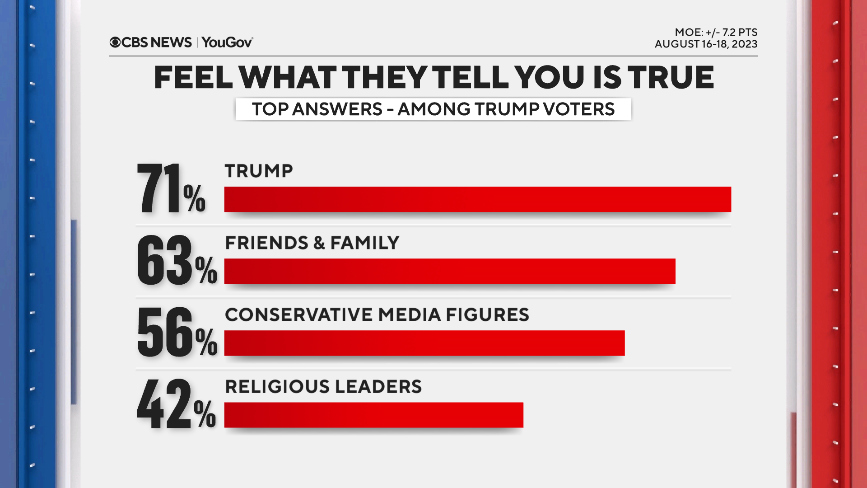
Another side note: the always cogent Timothy Burke has a blog post in which he wonders how anyone with even a modicum of sense would ever go to work for Trump (whose record of treating his helpers dismally is unambiguous and exists in plain sight).  Burke doesn’t have any good answers; he can only shake his head in disbelief.  Even if Trump is on the rise, no one ever benefits from hitching their wagon to his star.  His narcissism can’t abide sharing his triumphs (and whatever fruits those triumphs yield in the way of money, fame, or power) with anyone.  Of course, Burke’s puzzlement here only echoes the wider puzzlement over the cult of Trump among such a large share of the populace.  This recent CBS poll boggles the mind.  Among Republican voters, Trump is deemed more honest than everyone else in their lives by large margins.  (Even more than intimates, although the gap there is much lower.  Only 8% trust Trump more than their family members.)  So much for Hannah Arendt’s sophisticated take on the general cynicism generated by authoritarians, that is, the notion that everyone knows they are lying, but just think “everyone lies” and shrug.  No: the lies are believed; they are deemed the only truth out there.  (See NOTES below for references.)

But back to Gaita.  Because treason (on his take) “undermines . . . the conditions which make it possible for a people to speak as a people, . . . the most fitting (though not, any more, practical) punishment for unrepentant traitors . . . is banishment” (257).

What a lovely thought!  I don’t actually see why banishment is “not, any more, practical.” Surely we could send Trump abroad—wonderful to think he would flee to Saudi Arabia—and then keep him from re-entering the United States.) In any case, since banishment is not on the table, let’s at least indulge our fancies in thinking how appropriate the penalty would be in Trump’s case.  What he craves is admiration and adulation.  Deprive him of his audience, of the “people” to whom his plea for attention is made, let him fulminate in the emptiness of cyber-space entirely outside of the context (an actual civic association) to which his tweets are addressed.  Delicious.  The punishment would fit the criminal (and, possibly, also the crime) in a Dantesque manner.

NOTES

The Timothy Burke blog post on Trump’s henchmen. 

The CBS poll:  https://www.cbsnews.com/news/trump-poll-indictments-2023-08-20/

Here’s the most relevant finding in that poll, but it’s very much worth looking at the entire poll results (available through the link).

trump-truth.png

Finally, the relevant Hannah Arendt passage that has been making the rounds over the past eight years as pundits and others try to come to terms with the phenomenon of the Trump cult:

In an ever-changing, incomprehensible world the masses had reached the point where they would, at the same time, believe everything and nothing, think that everything was possible and nothing was true… The totalitarian mass leaders based their propaganda on the correct psychological assumption that, under such conditions, one could make people believe the most fantastic statements one day, and trust that if the next day they were given irrefutable proof of their falsehood, they would take refuge in cynicism; instead of deserting the leaders who had lied to them, they would protest that they had known all along that the statement was a lie and would admire the leaders for their superior tactical cleverness. (From The Origins of Totalitarianism)

Arendt’s take has proved both too sophisticated and too optimistic.  What we have seen instead is that no amount of “irrefutable proof” will lead the cultists to recognize the lie as a lie.  The cultists don’t have to retreat to the redoubt of cynicism.  They just double down on their belief in the original lie—and in the figure who propagates the lies.