Americans Are Down on College

Noah Smith, at his Substack blog Noahopinion, posts poll data that shows a precipitous loss of faith in college among a wide swathe of Americans. (https://www.noahpinion.blog/p/americans-are-falling-out-of-love?utm_source=substack&utm_medium=email)

Here’s the grim chart that sums it all up:
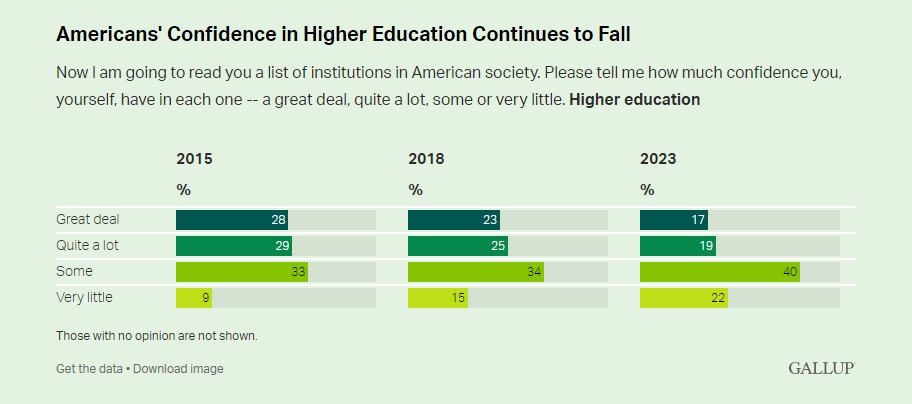
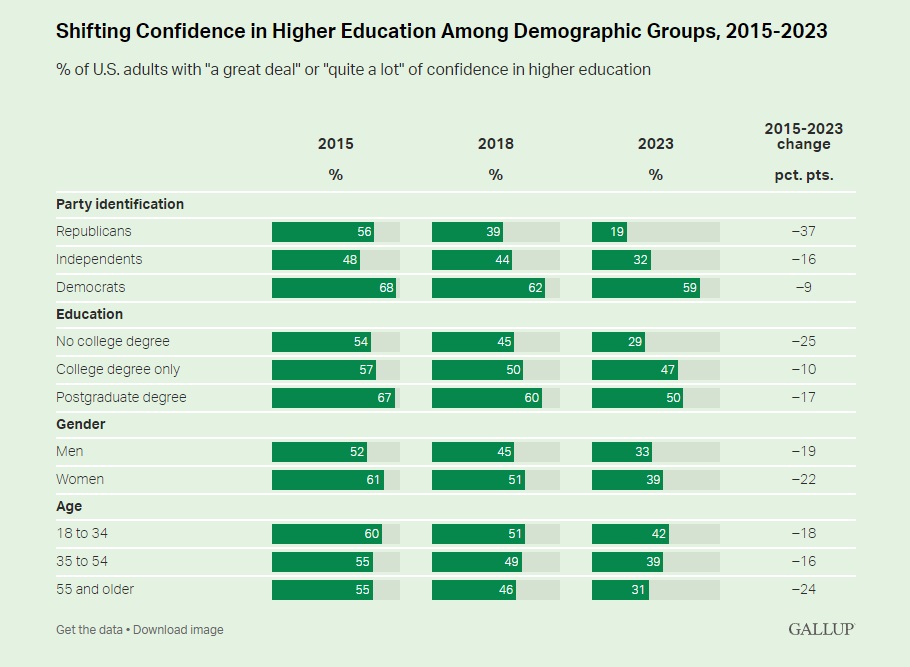
This disenchantment with college is more marked among Republicans—which is no surprise given the profound anti-intellectualism of current day Republican populism joined to the constant attacks upon universities as citadels of liberalism.  But Democrats also have much less faith in the usefulness of a college education.  Here’s the chart that details the demographic divides on this issue—helpfully giving us the percentage declines since in 2015 in the far right column.
I am just back from the Tennessee mountains where I was visiting with two friends who are English professors at the University of Tennessee. So the plight of the humanities inevitably came up.  Which isn’t exactly the decline of faith in college tout court.  But is adjacent to that decline.

Anyway, my line was: we no longer have any story at all that we can tell, that feels even remotely plausible, about why someone should be conversant with the cultural heritage represented by the texts of the past.  The only rationale anyone ever advances these days is about skills acquired as by-products of reading: critical thinking, pattern recognition, attention to detail, ability to track complex arguments or emotional states complete with competing points-of-view and ambiguous data etc.

Similar arguments are used to justify instruction in writing.  Vital communication skills and all the rest. 

But even its most ardent practitioners can no longer—in the face of a culture that clearly does not care in the least—make the case for being an educated or “cultured” person, where attaining that status entails familiarity with a cultural heritage marked by certain landmarks, with that familiarity widely shared. 

When I taught at the Eastman School of Music, our dean would often lament that the audience for classical music largely consisted of 60+ year olds.  What would happen when that audience died off? Well, so far, it turns out that the next cohort of 60 years olds takes their place. 

I am currently experiencing something similar.  I facilitate two different reading groups (with ten participants in each) of people in their 60s who want to read classics. My sixty year olds in the two reading groups are hungry for encounters with “great books.”  Some of the books are ones they read in college and want to revisit.  Other selections are books they have always wanted to tackle.  So we have read Homer, Dante, Augustine, Dostoyevsky, Joyce, Woolf, Cather, Morrison and Cervantes among others. (Both groups have been going strong for three years.)

Are my readers outliers?  Yes and No.  They are products of the time when most students were liberal arts majors (English, History, Religious Studies etc.) and then went on to professional careers in business, law, journalism, and even medicine. Like (I would argue) the classical music audience, they had early experiences reading “major authors” (just as the classical music audience had early experiences of learning to play piano or violin and were taken to hear orchestras.)  After reaching a certain pinnacle in their professional lives (and after the kids are grown and gone if they had them), these oldsters turn back to the classics.  Not everyone in their position makes this turn, but a fair number of people do.  They are hungry for the “culture” that they tasted for a while in youth, and now want to revisit it.

The current situation is different because, especially when it comes to books more so that when it comes to music, the early experience is not on offer.  A certain subset of the population still gets violin and piano lessons.  But fewer and fewer young people are getting Homer, Woolf, or Conrad in either high school or college.  There is no early imprinting taking place.

And what are my readers seeking? In a word: wisdom. They are looking for life lessons, aids to reflecting on their own lives.  They are just about completely uninterested in historical or cultural context, the kinds of things scholars care about.  So the humanities have an additional problem in the context of the research university which is supposed to “produce knowledge.” Why does a society want knowledge about the cultures of the past (its own culture and other cultures) and about its highlighted landmarks?  We humanists don’t have a good answer to that one when faced with the general indifference.  We can echo the complaints of Matthew Arnold about the philistines who prevail in our society, but we lack his faith that “culture” has something precious to offer that society.  And certainly even an attempt to activate Arnold’s vision of “culture” would have little relation to what counts as “scholarship” in the contemporary university. Arnold, too, was mostly focused on gleaning wisdom (“the best that has been thought”) from the classics–although he also hoped that attention to “culture” could provide a “disinterested,” reflective place to stand that would mitigate partisan wranglings. Even in 1867, that last one seemed pretty laughable, and certainly naive.

Still, there was a time when offering wisdom, or paths to maturation, or lessons in the practices of reflection was valued as something college could (and should) do.  But such vague values carry no water in our relentlessly economic times.  Starting in the 1980s (greed is good) when the gap between economic winners and losers began to widen and it also became clear that there was wealth beyond previous imaginings for the winners, return on investment became all.  The decline of support for college is pretty directly tied to a cost/benefit analysis that says the economic pay-off of a college degree has declined.

The facts of that matter are complex.  Overall, it’s still a winning economic strategy to get a college degree.  It is even unclear whether a degree in a “practical” major like business or health services carries a better economic return than a liberal arts degree in history or literary studies.  Determining the facts of this matter are complicated by the extent to which social/economic starting point influences the eventual outcomes along with where one degree is from (given the extreme status hierarchy in American higher education).

But it is simply wrong that college is an economic loser.  So why the decline in faith in college? One, the upfront costs are now so much higher than they once were.  People go into debt to get a college degree—and the burden of that debt weighs heavily on them precisely when they are setting out and in their most vulnerable, least remunerative years of their job lives. 

Second, the relentless attack on what is taught in college for the right wing outrage machine. The strong decline since 2015 registered in the Gallup poll is much stronger among the groups (Republicans and those without a college degree) most susceptible to right wing propaganda.

But we should recognize that the right-wing attack exists alongside a wider and growing sense that college’s sole purpose is job preparation. As a result, much of the traditional college curriculum simply seems beside the point, a waste of time.  The degree is what matters; the pathway to that degree is now deeply resented by many students.  It is experienced as a pointless, even sadistic, set of obstacles—and the sensible course of action is to climb over those obstacles in the most efficient way possible. (Hence the epidemic of cheating, and the documented increase in the numbers of students who think cheating is acceptable.)  What is offered in the classroom is experienced as having no value whatsoever.  The only value resides in the degree—a degree that is only slightly (if at all) connected to something actually learned (whether that be some acquired skills or something more nebulous like wisdom.) 

We humans seem particularly adept at this kind of reversal of values, making what at first was a marker of accomplishment into the aim of our endeavors.  Money becomes the goal instead of a signifier of values, only valuable insofar as it enables access to things needed for flourishing; in a similar fashion, the degree that was simply meant to signify educational acquisition of valuable knowledge is now the goal of the pursuit, with the actual knowledge radically devalued. 

Our politicians have acted on this reversal of values.  Public higher education is now driven by the imperative to deliver as many degrees for the least amount of public expenditure.  That the actual educational outcomes (measured in other terms than simply the number of degrees granted) are devastated by this approach doesn’t trouble them in the least because they buy into the general contempt for the actual content of what gets taught in the college classroom.  That the credential (the degree) is divorced from actual competence or knowledge apparently doesn’t bother them either.  It’s all numbers driven, with no attention at all to quality.

When we reached this point in this conversation among four English professors (the youngest of whom was 70), we lamented we had become the cranky oldsters we swore we would never become.  Spouting the all too predictable: “How it was so much better in our day.”  Another blogger I like, Kevin Drum, spends a lot of time debunking the notion that Americans, including young Americans, are worse off today than in years past. (Link to Drum’s blog: https://jabberwocking.com/) When one adjusts for inflation, housing costs and other economic indicators (like wages), things in the United States have been fairly steady over the past 70 years. The key point is that economic inequality has increased.  The lower half has mostly held steady, while the upper 20% has taken all of the wealth generated by economic growth over that time span.  So the have-nots are not more destitute (they are even slightly better off), but they have to witness the excesses of those who are much more wealthy than they were in the 1950s and 60s.

I think, however, that Drum misses the fact that economic anxiety is way higher, even if that is mostly a factor of the reaction to numbers.  To face a monthly rent of $3000 feels more daunting even if that’s only $350 in 1970 dollars.  The same goes for college tuition and student loan debts.  Especially when college costs have risen faster than the rate of inflation.

So the sheer sticker shock of college costs has to be seen as one factor in the disillusionment.  Despite generous aid packages, studies show that the price is off-putting for lower income students—precisely the students least likely to know about how aid works.  Add to that the fact that most aid packages also include loans and the upfront financial burdens and risks are daunting. 

I used to say there was only three things the world wanted to buy from the US: our Hollywood centered entertainment, our weapons, and our higher education. I think that may still be true, but we sure seem determined to undermine two of the three, leaving only our heavily subsidized defense industry standing.  Withdrawal of government support for education (shifting the costs onto students) hurts the one, while corporate greed (screwing the writers, actors, and other workers) hurts the other.

It is a truism that the periods when the arts flourish are also when a nation is most prosperous; think Elizabethan and Victorian England; 5th century Athens; early 15th century Florence etc.  The 1950s and the 1960s may not have been such a golden age for artistic achievement, but it was a time of economic well-being.  And that fact seems to have generated the confidence that allowed for a non-utilitarian ideal of a liberal arts education to flourish.  Yes, that ideal was a “gentlemanly” one, which meant it excluded women, non-whites, and large swathes of the working class.  But the GI Bill and the massive investment in public higher education during those years was the beginning of the opening up of that model of college to larger numbers.  The retreat from that ideal is not (as Kevin Drum’s work repeatedly demonstrates) the result of America being less prosperous in 2020 than it was is 1965.  Rather, it is the fact that completion for a piece of that wealth has been greatly increased.  An economy that produced general prosperity (again, with the important caveat that it excluded blacks from that prosperity) has been transformed into one where the gap between winners and losers has widened—and is ever present to every player in the field.  (Why do American workers not take their vacation time?  Because they are terrified that their absence will prove they are not essential—and so they will be laid off.)  The things that our society has decided it cannot “afford” are legion (health care for all; decent public transportation; paying competitive wages to keep teachers in the classroom).  Among those things is a college education that has only a tangential relation to a specific job as it aims to deliver other benefits, ones that can’t be easily or directly tied to a monetary outcome.

Kenneth Burke

I am working my way through old thumb drives and came across this introduction to Kenneth Burke’s work that I wrote for some sort of Blackwell Companion. I do not know if it ever was published. But the essay strikes me as a useful overview of Burke’s work. So I offer it here for what it’s worth.

     Kenneth Burke is an American polymath whose work offered an alternative to the New Criticism by focusing on the pragmatic ways that literature serves as “equipment for living.”  His resolute refusal to understand the literary as a distinctive use of language or literary criticism as a discipline separate from wider sociological analyses anticipated the move away from formalism and return to context characteristic of literary theory in the 1980s and 1990s. 

     Ever the maverick, Burke never graduated from college.  He quit Columbia after a year and took up residence in Greenwich Village in the early 1920s, where he associated with American modernists such as William Carlos Williams.  He served as editor of the important modernist little magazine The Dial, wrote poetry, novels, and criticism, and also took up various social science research jobs to pay the rent.  His work is influenced by such an eclectic assortment of figures—from medieval theologians like Duns Scotus through to Nietzsche and the social psychologist G. H. Mead—that it comes as no surprise that he has proved uncategorizable.  He belongs to no discipline and founded no school, even though his books are endlessly suggestive and have proved particularly important to academics in rhetorical and communication studies.  Burke never held a formal academic position although he did teach for many years at Bennington College and lived long enough to bask in the acclaim when a new generation of literary theorists discovered him at the end of the twentieth century.  

     Burke’s work relevant to literary theory is best divided into three phases.  This division is somewhat artificial, but it helps to organize an overview of his long career.  The first phase encompasses his work during the 1920s and 1930s, particularly the key texts Permanence and Change (1935) and Attitudes Toward History (1938), as well as the essays collected under the title The Philosophy of Literary Form (1941).  During these years, Burke did not offer a handy name for the kind of work he was doing, but he can be seen groping toward a dynamic account of literature that can do justice to its expressive and social power.  On the expressive side, Burke argues that literature allows for the hypothetical examination of “attitudes,” of possible ways of relating to the self, to others, and to the world.  Attitudes, Burke insists, are “incipient actions.”  To take a stance toward the world is to relate to it in a particular way and, subsequently, to act on the premises embedded in that relation.  Literature offers the fullest possible play for an imagination of possible actions and their potential consequences.  What particularly catches Burke’s attention—and defines his genius as a literary critic—is the way literary texts “convert upwards and downwards” by changing names and contexts.  Hence, for example, by conversion downward, Aschenbach’s desires in Death in Venice can be rendered as the lust of an old man for a young boy.  But conversion upward would read his desire as a love that opens up to him realms of insight previously unavailable.   

     Crucially, the “logic” of literary texts is never straightforward, but rather tied to the development of tropes, doubling of fictional characters, associations triggered by puns, and flights of fancy that often defy explanation. Thus, literature illustrates the ways humans create values and “reasons” (motives) for action, while also providing the means foe personal and social transformation. The various metamorphoses and associational pairings in texts extend outward from the author or the protagonist to include the audience and, through them, the social.  Partly through his affiliations with “Popular Front” leftists who were trying to forge mass political movements in the 1930s, Burke becomes interested in “rhetoric,” in the ways that artistic works can serve to constitute communities.  Literature has real-world impacts both by priming selves to act and by creating groups that cohere through “identification” with the same goals, same leader, or same overarching vision (ideology).  By 1941, partly through his famous essay, “The Rhetoric of Hitler’s Battle,” on Mein Kampf, Burke had become fascinated by the plot and figurative dynamics through which a text identifies (produces) a “foreign” element, a scapegoat, and sets about to purge it.  This interest in scapegoating persists throughout the rest of Burke’s career.

     The second phase of Burke’s career sees him attempting to systematize his insistence that “literature is symbolic action.”  Following in the footsteps of pragmatist social theorist George Herbert Mead, Burke tries to develop a full-scale philosophy of the act.  (The parallels to the work of Russian literary theorist Mikhail Bakhtin are striking, but Burke, like others in the West at the time, did not know Bakhtin’s work.)  Burke calls his theory “dramatism” and planned to expound it in a trilogy: A Grammar of Motives (1945), A Rhetoric of Motives (1950), and A Symbolic of Motives.  This last work was never completed, although pieces of it were published in a volume entitled Essays Toward a Symbolic of Motives (2006) after Burke’s death.  By “motives,” Burke means the attitudes, values, and beliefs that move a person to act.  His “grammar” attempts to identify the necessary conditions of any action, of which there are, he says, five: the act, the agent, the scene of action, agency (means), and purpose.  A Grammar of Motives offers what amounts to a history of philosophy in terms of which of the five elements a particular philosophy emphasizes.  To take “the scene” as most crucial, for example, leads to naturalism and other kinds of determinism that view the environment as dictating what actors do.  To place the greatest emphasis on the agent would mean the kind of voluntarism we associate with certain extreme versions of existentialism.  The “ratios” that try to weight the different roles played by the five elements can be quite complex and Burke traces out these intricacies through commentaries on a dizzying array of figures from the history of Western thought. 

     Presiding over the whole enterprise, although this is never explicitly acknowledged, is Hegel, partly because Burke in this middle phase aspires to the kind of all-encompassing system that Hegel also strives to produce.  But most importantly because the mode of thought is relentlessly dialectical.  For Burke, any philosophy that highlights one element of the pentad at the expense of another will inevitably produce a reaction, a new theory or philosophy that picks up the neglected item.  His philosophy, by way of contrast, will try to be inclusive, to do justice to the roles played by all five elements.  I think it fair to say that Burke’s does not realize his systematic ambitions.  A Grammar of Motives is usually accounted Burke’s masterpiece, but that is for the wealth of insights it offers on an astounding range of topics and figures, not because he constructs a grand synthesis.  In fact, despite his aspirations, Burke is not a systematic thinker.  He is constantly chasing side thoughts.  His digressions are famous and his distinctive style—full of italics, scare quotes, and parentheses—reflects the almost manic quality of his thinking, always on the edge of skittering completely out of control.

     A Rhetoric of Motives then considers “the use of words by human agents to form attitudes or induce actions in other human agents.”  Rhetoric is the social component of language, focusing on its use to form communities and foster action in concert.  It involves “the use of language as a symbolic means of inducing cooperation in beings that by nature respond to symbols.”  Burke especially emphasizes “identification” of a recognizably Freudian sort.  The rhetor aims to get his audience to identify with, to feel themselves “consubstantial” with a group or an ideal.  One effective way to achieve this goal is by processes of association that link the group or ideal the writer wishes to promote to already cherished values.  So, for example, I might try to liken the effort to combat global warming to the program that sent human beings to the moon.  I would try to transfer the positive feelings about the mission to the moon to a willingness to get enthusiastically involved in this new effort. 

     Presumably, the final volume of the trilogy was going to examine the specific symbols that language utilizes as human agents form their motives.  The reasons Burke failed to complete that third volume are unknown.  Obviously, he struggled with it since he went over ten years before publishing his next book, The Rhetoric of Religion (1961).  And that new book introduced another shift in his work, from “dramatism” to “logology,” Burke’s third phase.  This new vision picks up a major theme in A Rhetoric of Motives and pushes it to its logical conclusion.  Burke argues that any linguistic account that aims to describe a scene comprehensively will inevitably produce a hierarchy of terms that leads from the smallest particular up to the highest, most inclusive term, which Burke labels a “god-term.”  For example, physics moves from sub-atomic particles up through atoms and molecules to something called “matter.”  For Burke, “matter” is physics’ god-term, which functions, crucially, both as the motive of the whole enterprise (to offer an explanation of matter) and to exclude certain considerations (physicists do not acknowledge spiritual causes).  “Logology,” then, would be the analysis of any system of linguistic ordering that details its hierarchy and thus understands what it aims to achieve and what it serves to exclude.  The problematic claim is that every use of language, no matter what the field or the occasion, has precisely the same structure.  Burke appears, in his final works, to adopt a tragic determinism.  Humans are always and everywhere addicted to hierarchy and to monistic, mono-theological, modes of thought that always produce excluded victims, punitive orthodoxies, and the conflicts generated by various heresies.  The essays collected in Language as Symbolic Action (1966) reinforce this tragic vision by offering sweeping definitions of “Man” and of “Language.”

     Paradoxically, Burke’s vision narrows as a result of his attempt to be all-encompassing.  The universalism of the claims made during his “logology” phase makes everything look the same—and this from a writer whose greatest strength was his unsystematic, even chaotic, enchantment with particular cases.  Seen this way, Attitudes Toward History becomes Burke’s strongest book since it focuses on their being plural possibilities, a variety of different attitudes (with an “s”) that humans might adopt as they face the world and decide how to act, how to live, within it.  Similarly, the resources upon which humans can call as they take up this task are many.  The book offers a catalogue of those resources without ever claiming that any must be chosen or that any choice has inevitable consequences.  Not surprisingly, in surveying this open field, Burke comes to announce that his own perspective is “comic,” a perspective, he claims, that “by astutely gauging situation and personal resources . . . promotes the realistic sense of one’s limitations” yet does not succumb to a “passive” fatalism.  Human action cannot carry all before it, but it is not utterly futile as well.  Learning to roll with the punches is the great comic virtue, an adaptation of attitude to circumstance.  Burke at his most magnificent awakens us to full glory of human resourcefulness—and highlights how literature especially puts that ingenuity on display while also putting it through its paces.

“The New Earth” and the 1970s

I have just finished reading the novel, The New Earth, by Jess Row.  In many ways it is a mess of a book.  About a dysfunctional family, one that the novel overburdens with not one trauma, but five.  I won’t list them to avoid spoiling your reading pleasure.  But let’s just say that it’s three traumas too many.  And there is a jejune bit of meta-fiction (or postmodernist high jinks) running through the book, in which “the novel” announces its requirements in ways that add nothing to the impact or import of the novel.

That’s because, as is usually the case, the novel’s excellence comes from its portrayal of an array of characters and the ways in which they strive to navigate life in the United States from 1970 to the era of Trump. (There are some masterful meta-fictions in which character and mundane observation play no role.  So I am not saying it can’t be done.  But it is very hard to pull off, and most excellent novels do what novels have always done, dissect society through the travails of individual characters.)

To be clear: The New Earth is the best novel I have read recently. I highly recommend it, flaws and all.

A loud despair runs through Row’s book; by its end, the three children of the family have declared the US unlivable—and take their father off with them into exile.  In one way, that’s why the multiple traumas are too much.  We don’t need over the top horrors to understand why people suffer in the contemporary US.  Enough to register the cruelties of everyday life—and the helplessness many of us feel about doing anything to remedy them.  The most sympathetic of the novel’s characters is the daughter who works as a lawyer trying to help terrified immigrants in Trump’s America.  We see how she is overwhelmed, with far too many cases than she could ever effectively handle, and fighting a judicial bureaucracy that even when it is not being deliberately cruel (which happens often enough) is battered into indifference by also being overburdened.

In short, the novel is just about the best account I have read of the pain and fear that comes from living in the contemporary world.  The family’s other daughter joins a peace group trying to protect Palestinians from Israeli settlers, so the horrors are not confined to the US. 

Not surprisingly, the novel has nothing to offer in the way of solutions—except finding a separate peace.  The characters leave the US in search of that peace, hiding out from history as it were, and tending to their own gardens.

Which leads me to the 1970s.  The parents of the dysfunctional family spend a fraught few years in the middle 70s in a Vermont commune presided over by a Japanese Zen master.  The novel does a marvelous job capturing the spirit of the 70s—which was a decade of separate peace making.  The failures of the revolutionary, transformative hopes of the 60s yielded the small-scale, personalized experiments of the 70s.  I know that’s a cliché, but Row makes it take on flesh.  The search for alternatives was real—and while never a mass movement, it did motivate a fairly large sub-culture. 

And Row’s novel ponders why it all fell apart.  Why, as if determined to show Margaret Thatcher was right when she declared there are no alternatives, a belief in other ways of living, in an ability to create and sustain those other ways, just dissipated, leaving nary a trace behind.  It all just disappeared: the hope, the experiments, the conviction that mainstream society was not just cruel, but fully and truly insane. The determination to have no part in that insane society–and the various ways people actually acted on that determination. Not some fantasy of moving to Canada, but setting out to establish communities where a different life could be lived and sustained. The novel’s ending–with its surviving characters going into exile–both reprises the 70s despairing conclusion that only a separate peace is possible with the added despair of not even believing one can, with friends, create the place of that separate peace. No running away to create a community, just running away, is all we can manage to imagine (and sometimes, although rarely, do) in the 2020s. After all, how many people really do move to Canada?

I graduated from college in 1974 and immediately started grad school in the fall of that year.  I didn’t know anyone who was dropping out to pursue some utopian alternative.  My fellow students at Georgetown were disappointedly conventional and conservative.  No doubt most of them voted for Reagan a few years down the road.  The atmosphere at Buffalo was entirely different.  I had traded conservative kids from Northeastern Catholic high schools for Jewish grad students, a surprising number of whom were “red diaper” babies.  From being just about the most radical kid on campus in DC, I went to being a boring middle-of-the-roader in upstate NY. 

Grad school in Buffalo during those years was a mess; apparently its teetering on the edge of anarchistic chaos was the after effect of its actually having been mired in anarchistic chaos in the years from 1968 to 1972.  A kind of fragile order had been restored, but there was still a lot of pulling in various contradictory directions, basically filling the whole spectrum from the Trotskyite Sparticus revolutionaries to the careerist academics on the faculty and in the grad student ranks.  The careerists were on the defensive and a distinct minority in Buffalo.  It wasn’t until I got to Berkeley in 1977 that I encountered true academic careerism in all its tedium and stuffiness.  The kind of place where people would not venture an opinion because something “was not in their field” and where obsession with the “profession’s” pecking order, both locally and nationally, was as pronounced as any minor Austen character’s constantly reaching for his Debrett’s. 

All of this to say that in Buffalo one could imagine that academics was itself an alternative.  Having one’s cake and eating it too.  Certainly that was the case for me.  After all, I ended up in Buffalo halfway by mistake.  I would have gone to Yale or Cornell if they would have had me.  I did know that Buffalo was at the forefront of “theory”—in which I was interested.  But I would have gone to deadly conservative Minnesota if they had given me a better stipend.  So I wandered into the Buffalo anarchy with only the dimmest idea of what I was getting into.

But I had been reading the various radical tracts of the 60s—Marcuse, N. O. Brown, Charles Reich, Philip Slater.  So I did have the image of books that could intervene in the here and now, that were promoting alternatives, that were paving the way toward a transformed world.  So I was primed already to think I was preparing myself to be a similar kind of prophet, one who mobilized ideas to move the world forward. 

I think it is that image of an audience that meant I could never have fled into a commune.  Prudence no doubt also played a huge part.  I wanted/needed a job, a sinecure if you will.  Already in 1974 the American Philosophical Society was warning prospective graduate students that their job prospects were iffy.  A professor of mine at Georgetown ran into me the summer of 1974.  When he learned I was going to grad school, he advised me to learn a trade—carpentry or electricity—along the way, so I would have something to fall back on.  A far different take (and a more refreshing one) than my encounter in 1978 with one of the Berkeley professors I had gotten to know.  I told him I was doing adjunct work for $900 a course at the University of San Francisco while I looked for a tenure track job.  What kind of tenure track job, he asked.  In my dreams, a liberal arts college.  Well, he replied, have you contacted Reed?

Back to prudence.  I couldn’t step off the pier into the unknown of a commune.  But I also couldn’t do it because I wanted to address the world.  I wanted to be a writer and I wanted an audience.  So I needed to believe (and it proved, eventually, approximately true) that the academy would afford me the freedom and autonomy and financial means to do my own thing, to pursue what interested me and what I thought should interest (and influence) others.  There was a long apprenticeship, with freedom only coming after tenure, but the academy did deliver something like an alternative way of living—even if the dreams of influencing others, of contributing to a transformation of America life, did not (could not?) come to fruition. 

Thus, my own 1970s hopes were dashed; the robust goals of dramatic change scaled back to the miniature spaces of the classroom and the family.  Even my efforts at transforming academic culture came to naught.  I spent most of my academic career at UNC trying to break the strangleholds of departments and of individually conducted research in how the university organized itself and how faculty experienced their careers.  To no avail.  Nothing I did in that regard had even a minimal impact.

True, UNC is a particularly conservative place.  True interdisciplinary structures and fantastic collaborative work have been introduced and have flourished in other places.  But I couldn’t get UNC to move in those directions.  I had plenty of co-conspirators (so my use of “I” here is misleading), but we failed.

In other words, I ended up with my own separate peace.  I had a more than satisfactory career, in terms of loving my students and the classes I taught, in terms of writing what I wanted to write to the best of my abilities, in terms of the respect and regard of my students and colleagues.  But nothing I did made any difference in terms of providing alternatives to the way life is organized and lived in the US.  I could only watch—as so many of my generation did—while the dominant mode (call it “neoliberalism” if you will; I have called it “the return of ruthless capitalism”) only tightened its grip on every corner of the world.

That tightening grip somehow—and this is where Row’s novel is very strong—also obliterated the pockets of alternative communes and their like.  Somehow?  After all, what threat were a few scattered dissident communities, far from the mainstream, tiny in their numbers and their power?  Yet they, too, had to be driven into the maw.  Swallowed whole and made extinct.

How?  Part of the story is the inflation of the late 1970s.  It is hard to convey to people today how cheap life was in the early 70s.  My grad stipend was $270 a month; if you were paying $75 a month for rent in Buffalo in 1974, you hadn’t looked hard enough.  If you had no income, no steady job, you couldn’t expect raises that at least took inflation into account even if lagging behind.  Things that could be done for almost no money in 1972 (like finding a place in the country and scraping by on what you could grow and casual labor) were impossible by 1978.  Poverty—real, soul and body destroying poverty—drove people off the communes as the decade unfolded.

There were multiple other causes as well.  But I want to return—and end—with this question of audience.  The communes were always, to some extent, demonstration projects.  They were meant to prove to a skeptical world (which, in reality, might shrink down to skeptical parents and other family members) that an alternative was possible.  But you couldn’t go into a commune unless you also had very strong ties to your fellow communards; they were the audience you were most cathected to.

That’s where I didn’t have it.  I was cathected to the imaginary audience of readers.  Those were the people I wanted to address.  I had turned my back on my parents, had succeeded to a large extent in not caring a whit if they approved of what I was doing or not.  We didn’t share any values by that point; they were Catholic Goldwater Republicans.  My only retained inheritance from them was a strong commitment and emotional attachment to monogamy.  I had no interest in or sympathy for 70s sexual experimentation or revolution, although very sympathetic with both feminism and the gay liberation movement. 

In any case, I was not attached to a local audience or community.  The lack of such ties meant setting off into the woods with a small group of like-minded others was never a possibility for me.  But, inevitably, the courage and romance of that attracts my admiration.  And the failure of those efforts both disheartens and intrigues me.  Why couldn’t they by sustained?  And why, today, have we gotten to the point where such utopian efforts don’t even exist any more?  A total loss of hope—and of vision—and of deep attachments to a cadre of others. 

We are thrown back on the family—or on church communities.  There is almost nothing else in the way of lived solidarities out there. Especially if we think of institutional supports for those solidarities. Yes, there are networks of friends, but never organized into ways of life, or (perhaps more radically) ways of sustaining life, of securing the basic necessities.  For that, you must go to the market; you can’t provide them for yourself through a small-scale collaboration with friends. 

That’s what the demise of the 70s spirit means.  Experiments are no longer even tried.  Everyone buckles under to the imperatives of the marketplace and to the intolerances of a society that scorns all alternatives and punishes those who, for whatever reason, cannot manage or refuse to bow to the demands of the market.  A society that visits the economic sins of the fathers on their offspring, making it well nigh impossible to climb out of the pit of poverty. 

So, yes, I miss the 70s with its sense of possibilities.  I was mostly a by-stander to, not a participant in, its experiments, which does seem a lamentable prudence.  But I was a fellow traveler in the sense of being a sympathizer.  I wanted the experimenters to succeed.  I hated the inevitable smug “I told you so” that followed the multiple failures.  I could mostly overlook the experimenters’ excesses and their often ludicrous rhetoric in order to honor their courage in trying to forge a new path.  And I can feel very melancholy when I read a novel like “The New Earth” and experience afresh the hopes that drove so many 70s alternatives and the eventual crushing of those hopes.

Justice and American Politics

I want to open by saying (which will prove ironic in light of what I want to say) that I am currently reading Dante’s Divine Comedy for my sins.

I have elsewhere said that I think the fundamental dividing line between right and left in US politics can be quickly characterized by their different understandings of what justice means.  To be blunt: I think this is one of the two or three most cogent and valuable insights I have had in my life.  So I violate my usual rule of not repeating myself to express the basic idea again in this post.

It’s not like anything I have ever proposed in print has been taken up by others.  But this one insight I do think could be of use, so it disturbs my sangfroid in ways the general disregard for my writings does not.

Here’s the basic idea—and how it relates to Dante.  In the Paradiso, Canto 7, Dante is at pains to explain the logic of the Crucifixion.  Basically, he says that forgiveness of an offense is not enough.  Justice is not served unless there is also “atonement.”  Some price must be exacted in order to cancel the debt the offense has created.  (These economic metaphors are completely and utterly inescapable once some “payment” is required for having done wrong.  Similarly, one cannot avoid talking about “reward” for good deeds when operating within the same paradigm.)

Of course, Dante’s Inferno is the place for individualized atonement—and Dante can barely conceal his glee that the big reprobates have to pay the price forever.  No atonement can suffice in their case.  The Crucifixion is about atonement for original sin, for the whole mass of human sins. Canto 7 explains why only the suffering of Christ could erase that stain. God can’t just forgive mankind its misdeeds. (Of course, it’s easy to ask “why not?” And it won’t surprise you that Dante’s answer to that question is tortured and not very convincing. His answer: humans, via Adam’s sin, had fallen from the perfection with which they were created. Being imperfect, humans could not themselves restore their perfection. Only God could do that–and he could only do it be becoming human himself and “atoning” for Adam’s sin by suffering death by Crucifixion. And answer that raises more questions than it answers–in my humble opinion.)

When it comes to individualized punishment in hell, Dante is usually a bit too human to rejoice in the sufferings endured by those he encounters, but he has no doubt of the justice of their being there, as stated (among other instances) in lines 10-12 of Canto 15 of the Paradiso.  “It is well the he grieve without end who, for love of a thing that does not last eternally, divests himself of that other love” (where the “other love” is the love for and of God, a love that does last eternally.) There is just no atonement at all available for some people.

In short, there is always a soupcon of sadism and of self-satisfaction in the justice that motivates the right: people should get what they deserve.  So the bad guys should be punished, and the good guys (me!) deserve all the rewards you can pile up.  Meritocracy with a vengeance (quite literally).

The harshness is the point; it cannot be siphoned out to create some sort of “compassionate conservatism.”  Even if the paternalism imagined in compassionate conservatism were to be enacted, it would be within the strict limits of the family (i.e. citizenry).  Dubya may actually have been a sincerely compassionate guy, a true believer in No Child Left Behind (a noble slogan after all).  But the compassion was certainly not going to extend to Afghans or Iraqis.  The right is fueled by righteous indignation—and the desire to meet out punishment to those who “deserve” it, while augmenting the spoils divided up among the blessed. 

That’s why American conservatism is shot through and through with a certain version of Christianity.  Meritocracy—and the outraged sense that taxes take my hard-earned and well-deserved wealth and give it to the unworthy—is just another version of a religion built upon dividing sinners from non-sinners, and equating justice with the sinners getting hell and the non-sinners getting heaven.

Leftists are talking of something altogether different when they talk of justice.  Maybe you could torture the left wing notion of justice into the language of “desert.”  But the idea centers on what people deserve by the basic fact of being human.  What we owe to one another as humans.  Some basic set of ways to satisfy fundamental material and psychological/social needs.  The things required to render a life worth living.  The means to forging a flourishing life.  Shame unto the society that begrudges those things to any in its midst. Such a society is unjust.

The left’s idea of justice has some Biblical sources as well (of course).  But as Dante’s poem reminds us: ministers of vengeance and cupidity seem to usually have the upper hand in the Christian churches.  There are always heathens and heretics at the door—and surely god does not want you to extend a helping hand to them.  All that love your enemies stuff is overwritten by the doctrine of god’s eventual justice, of the fact of hell. If even God can’t love wicked humans, but sends them to hell, then there is a definite limit to what enemies you are enjoined to love.

So the two sides talk past one another.  The right sees threats, enemies, and (simply in some cases) the undeserving.  The reprobate not only bring suffering upon themselves,  but it also outrageous if society does not act to punish them, to make them pay for their waywardness. Why leave punishment to the next world when you can get the jump of divine vengeance in this one?

The left (bleeding heart liberals) saves its indignation for the cruelty of a society that treats those it deems unworthy so harshly.  Its cries for justice are for society to do right by these neglected souls, not to heap more suffering upon them.